A-Level Physics: connecting mathematics with physical reasoning
Connect mathematical models, measurements and explanations in A-Level physics.
When looking at A-Level Physics problems, not only are the calculations in the formulas complex, but it also takes time to understand which phenomenon the formula explains. Even students who enjoy physics need to study how to connect mathematical and physical concepts.
Connecting Formulas to Phenomena and Explaining with Data
Start with the Course Scope Tailored to the Exam Institution
Since the detailed scope and evaluation methods for A-Level Physics can vary by examination institution, it is necessary to check the specifications used by your school.
It is helpful to check if there were any difficulties in previously learned units, such as mechanics or electricity, and if there is any discomfort in interpreting functions and graphs in mathematics.
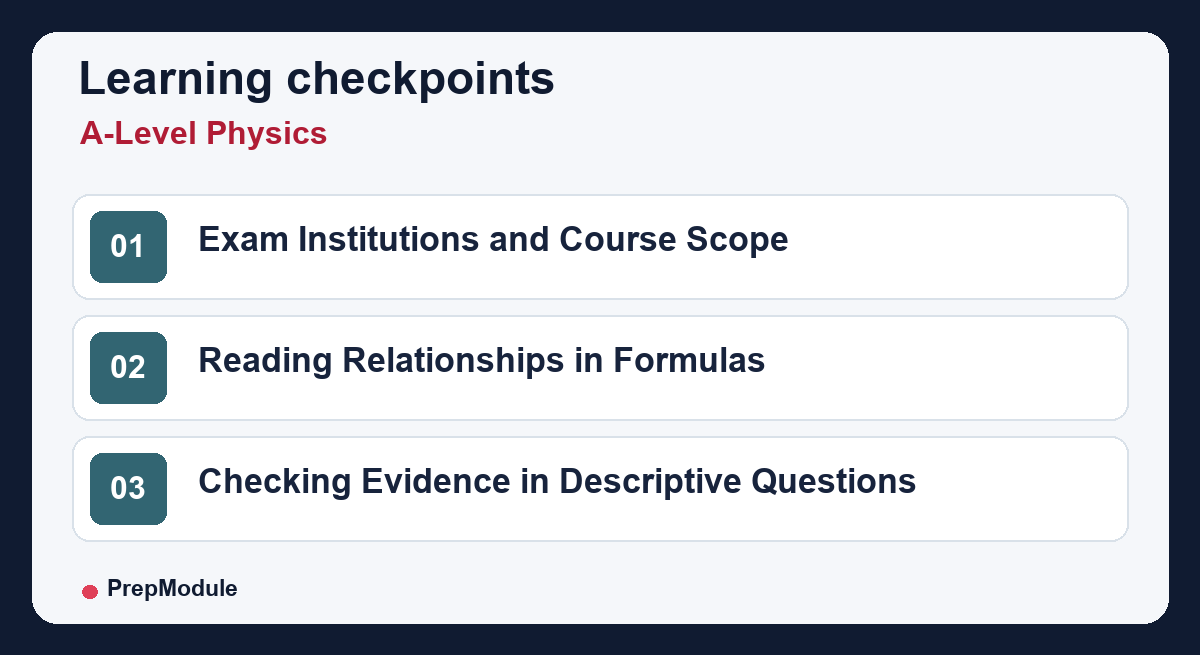
Practice reading relationships in formulas
For example, if one physical quantity is proportional to the square of another, it is a relationship where doubling the independent variable results in a quadrupling of the result. In addition to calculating using the formula, try to think about what kind of graph should appear.
If the measured value differs from expectations, you can examine the model's assumptions and the uncertainty of the measurement.
In descriptive questions, actual data serves as the basis
Look at the given data, explain the points where trends or differences appear, and then connect them to a physical model. It is important to practice not only the process of finding the correct answer but also writing down the rational reasons for that answer.
Each student misses different parts in mathematical calculations and concept interpretation.
Physical Models Have Assumptions
In a hypothetical problem where a constant-mass object moves under the influence of forces, F=ma connects the net force with the acceleration. However, in situations where multiple forces act on an object, using a single force directly as F can lead to incorrect calculations. Make it a habit to draw a free-body diagram representing the direction of the forces and the object, and then mark the assumptions that hold true.
Distinguishing Between Practical and Theory in Exam Preparation
In A-Level Physics, understanding not only concepts and calculations but also the experimental data, graphs, and measurement uncertainties covered in school is important. Check the exam papers and experiment-related assessments in the official syllabuses of Cambridge and Edexcel, respectively. Instead of simply organizing your incorrect answers by chapter, note which specific skill was involved—such as equation derivation, graph interpretation, explanation of data limitations, or unit conversion—to help you identify the direction for your review.
How to Plan Lessons by Exam Institution for A-Level Physics Preparation
Identify Subjects and Units/Components
Organize the exam institution (such as Pearson or Cambridge), your school's exam scope, and the math content you have studied. Even for the same physics concept, the question format and evaluation criteria may differ.
Practice the Problem-Solving Process
Represent the motion of an object using diagrams and graphs, select which physics principle to use, and then answer using formulas and units. Data interpretation and long explanatory questions can also be practiced separately according to your school's syllabus.
Focus on Specific Topics
If you are weak in Calculus or Vectors in Maths, reinforce the necessary foundations; if you have already mastered the concepts, discuss a class to study the practice problems and answer structures of the relevant exam board.
Checking Evidence in Descriptive Questions
Official resources
Inquiry about A-Level Physics Classes
PrepModule is an educational service that supports both international school curriculum classes and university admissions. We have tutors in Math, Physics, and Coding who majored in Computer Science at MIT, and we identify teachers suitable for the student's school curriculum and requested subjects.
You can apply for only the subjects and units you need, as many times as you want, without having to pay for a fixed package.
Please let me know your school's testing agency, Physics syllabus, and the chapters you are currently struggling with. I provide consultation on the areas you need, ranging from math basics to actual Physics problems.
