How IB Diploma grading works: subject grades, 45 points and passing requirements
Calculate your IB Diploma score out of 45 with six subject grades and TOK/EE core points, then read the official passing criteria.
Free study tool
Free IB 45-point calculator
Choose six predicted or final subject grades (1–7), plus the TOK and Extended Essay grades. HL and SL both contribute the same number of points to the total.
This calculates points only, not Diploma eligibility. CAS, minimum subject grades, HL/SL totals and the complete IB passing conditions must also be satisfied. No grades are stored or submitted. Official IB passing criteria and matrix.
If you are a parent preparing your child for the IB Diploma Programme (DP) at an international school, there is a number you may be curious about upon receiving the report card. Since the maximum score for each subject is 7 points, why is the final score 45 points? Let's examine together how accurate the claim is that a score of just over 24 points is required to receive a Diploma.
Properly understanding IB scores allows you to specifically identify which subjects your child is struggling in and what needs to be improved before the next exam.
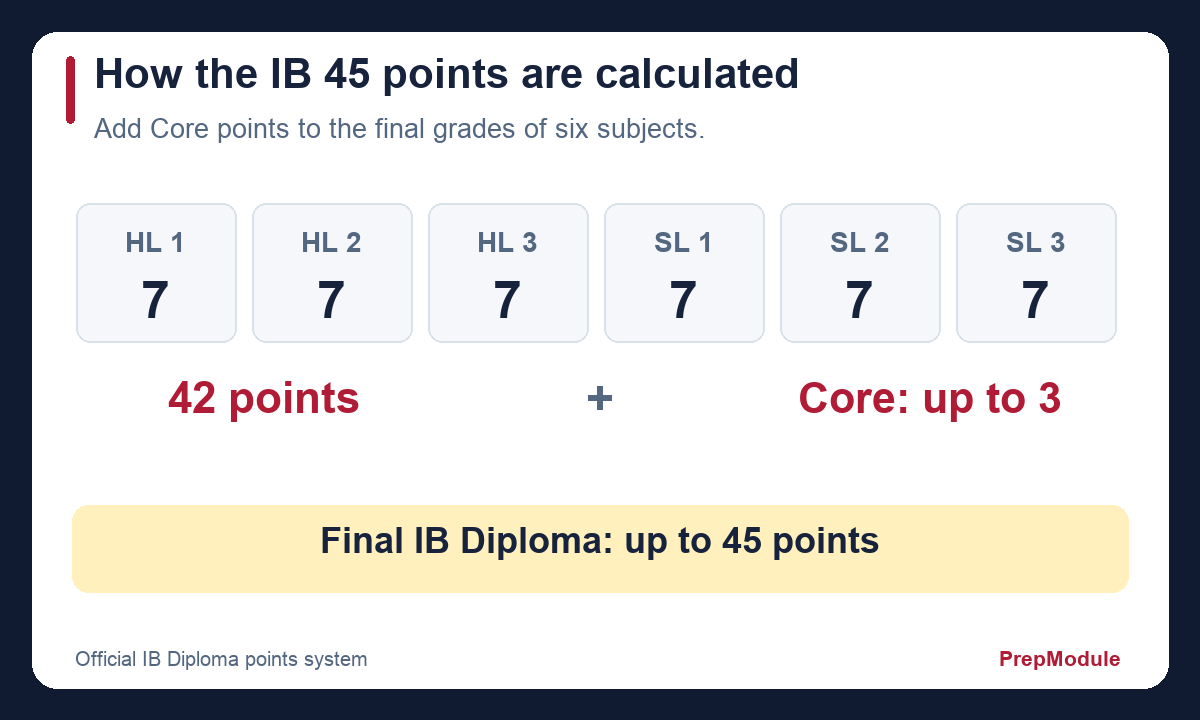
6 subjects × 7 points = 42 points, TOK·EE maximum 3 points = 45 points
How are 1 to 7 points calculated for each subject?
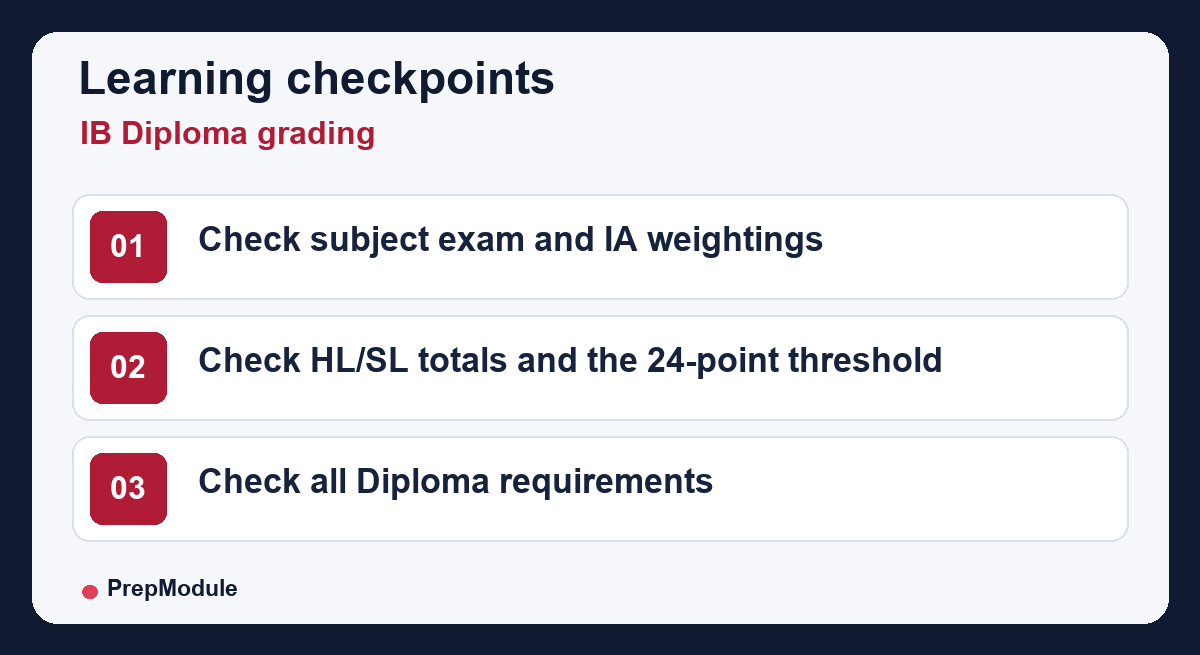
In the IB DP, there is a set assessment method for each subject. It is easy to assume that only end-of-year exams are taken, but many subjects incorporate both External Assessment and Internal Assessment (IA). Since the exam paper structure and IA weighting vary by subject, you must check the subject guide for the year the student is taking the exam.
For example, let's assume the weighting of exam scores and IA scores is 80% and 20%, respectively. If the exam score is converted to 70/100 and the IA to 90/100, the weighted sum is 70 × 0.8 + 90 × 0.2 = 74 points. However, the number 74 does not directly represent the subject score out of a maximum of 7 points. You must check the grade boundaries applicable to the assessment to determine the final grade. These weights and scores are hypothetical examples for illustrative purposes and are not the official score sheets for specific IB subjects.
Some assignments evaluated by teachers at school may undergo IB moderation. Therefore, the IA scores predicted by the school do not always match the final results.
HL and SL both have a maximum final score of 7 points.
While HL differs from SL in the scope and depth of study required, both carry a maximum of 7 points when calculating the final Diploma total. Receiving 6 points in HL does not add a larger score to the total than receiving 6 points in SL. However, universities may determine separately which HL subjects and minimum scores are required for each major. You must distinguish between university application requirements and the requirements for obtaining the IB Diploma itself.
How to view an actual report card: 33-point calculation example
Below are the grades of a hypothetical student who took 3 HL and 3 SL courses. The Final Diploma Score is calculated by summing the six subjects and adding the Core scores received from the TOK and EE combination.
| Section | Virtual Score | Subtotal |
|---|---|---|
| 3 HL subjects | 6 + 5 + 4 | 15 |
| 3 SL subjects | 6 + 5 + 5 | 16 |
| TOK·EE | Core 2 points | 2 |
| Final Diploma | 15 + 16 + 2 | 33 / 45 |
This student has a total score of 33 points. The HL 15 points and SL 16 points also meet the respective minimum sum requirements. Of course, other conditions, such as CAS completion and grades in all subjects, must also be reviewed.
You may not receive a Diploma even with a total score of 24 points or higher
The official IB qualification requirements do not look at the total score alone. You must receive a grade in all six subjects, and each subject must have at least a score of 2. You cannot have more than two subjects worth 2 points, and no more than three subjects worth 3 points or less. You must also receive a grade in TOK and EE; an E is a failing condition. CAS must be completed.
The basic requirements are a total of 12 points or more for HL and 9 points or more for SL. If you have four HL subjects, use the three highest scores; if you have two SL subjects, check the condition of 5 points or more for SL. For example, a student with HL 4+4+3=11 points, SL 6+6+6=18 points, and Core 2 points has a total score of 31 points, but does not meet the HL 12-point requirement. This is why you should not be complacent based solely on a high total score.
What should you check when looking at grade boundaries?
For instance, a student might wonder if their score of 75 on a mock exam falls into the 6 or 7 range. The IB applies grade boundaries based on assessment results by subject and exam session. Therefore, you cannot assume that a specific percentage always corresponds to a 7. Please check the scaled total mark, lower grade boundary, upper grade boundary, and the score required to move up one grade level displayed in the results with a DP coordinator.
Instead of vaguely aiming to increase your total score, it would be beneficial to start your study plan by comparing your past component scores with grade boundaries to identify the difference needed to reach your target grade. By separating and reviewing mistakes by test paper from the IA assessment criteria, you can establish your study priorities.
Shall we calculate the results if scores differ by Paper?
This is a hypothetical example illustrating calculation principles, not an actual standard for IB subjects. Let's assume the maximum raw mark for Paper 1 is 60 points, Paper 2 is 80 points, and IA is 20 points. If their respective weights are 35%, 45%, and 20%, and a student received 42, 56, and 18 points, it is not appropriate to use the simple sum of 116 points as the total score. When converted according to each evaluation weight, Paper 1 becomes 42/60 × 35 = 24.5, Paper 2 becomes 56/80 × 45 = 31.5, and IA becomes 18/20 × 20 = 18 points. The converted sum is 74 points. The ratios and rounding rules used in the actual calculation must follow the official evaluation guidelines for the respective subjects.
If the lower bound for a 6-point score is 67 and the lower bound for a 7-point score is 79 at the virtual grade boundary, the grade in this example is 6. This means that an additional 5 converted points are needed to reach 7 points, not that you simply need to get 5 more raw marks on the test paper. This is because the converted value varies depending on which evaluation element the score is secured from.
Why Predicted Grade and Final Grade Can Differ
The Predicted Grade (PG) a student receives during the university application process is a grade projected by the school based on past achievements and future results. The actual final IB grade is determined by official evaluation results. While schools can calculate predicted grades based on recent exams, assignments, and mock tests, not all schools use the same timing and methods.
If a student with a predicted score of 38 has received conditional acceptance, please note down the conditions required by the university separately. For example, if a university hypothetically requires a total of 36 points and 6 points in a specific HL subject, even if you receive a final score of 38, you may not meet the requirements if that designated subject is rated 5 points. The requirements for obtaining an IB Diploma, school projected grades, and university admission requirements are three distinct categories.
Practical Methods for Finding Priorities on a Scorecard
If a student receives 5, 6, 6, 5, 7, and 5 points in six subjects respectively and expects 2 points in Core, the total in the current plan is 36 points. However, the more important areas of study vary depending on whether each subject is HL or SL, what specific university requirements exist, and what level the IA is. You can create a specific plan by organizing the current grade, target grade, difficult components of mock exams, and IA feedback for each subject.
Do not mark only the subjects with low scores when creating your initial plan. You must verify whether the subject affects the minimum Diploma requirements, counts towards major admission requirements, and if evaluations are still pending. Ask your school coordinator how to interpret your actual grades and for any necessary related information. It is recommended to review the internal and external assessments and the grade calculation flow in the official IB assessment description.
What preparations can I discuss at PrepModule based on the IB score report?
Break down the 45-point goal by subject
Differentiate between the subject scores received from school, predicted grades, and the progress of TOK and EE. For example, if your three HL subjects are 6, 5, and 6, your current HL total is 17 points. Instead of feeling anxious based solely on your total score, identify which subjects or assessment elements have room for improvement.
Verify how the actual assessment is conducted
Check the weight of external exams and IAs for each subject, as well as school progress and assessment feedback, to identify areas of weakness such as conceptual questions, answer structure, and time management. It is recommended not to simply convert a single raw score from a school exam into a final IB score.
Consider both admissions and academic subjects together
We review the student's subjects, grades, and major with former U.S. university admissions officers, and necessary subject classes can be selected separately. Instead of promising the student's final grades or acceptance to a specific university, we plan consultations and classes based on areas that can be improved now.
Please record subject scores and Core scores separately, and check the Diploma requirements as well.
Official resources
IB Grade Management and Subject-Specific Classes
PrepModule offers international-school tutoring, SAT and TOEFL preparation, competition preparation, and U.S. college admissions counseling tailored to each student. Our tutors include an MIT computer science major and a research and writing tutor pursuing a PhD in Political Science at LSE. We check tutor availability and scheduling for your requested subject.
Instead of packages that include unnecessary classes, you can select subjects and class durations based on the student's situation.
Please let us know your current grades and goals for each subject, as well as any difficulties you are experiencing with exams or IAs. We will consult with you to determine the priority of necessary IB subjects first.
