Cambridge International A-Level grading: grade thresholds, PUM and AS carry-forward
Learn to read Cambridge A-Level grade thresholds, weighted marks, PUM and AS carry-forward rules, with a worked Mathematics grading example.
If you are a student preparing for A Level, the first step is to check which exam board your school uses. Cambridge International A Level and Pearson Edexcel International A Level interpret grade reports differently, even if the subject names are the same.
In Cambridge grades, the Grade Threshold and the Percentage Uniform Mark (PUM) frequently appear. It is easy to mistake Edexcel’s UMS for Cambridge’s PUM, but the two numbers serve different roles. Today, we will examine Cambridge’s calculation method and the actual publicly available Mathematics grade boundaries.
Compare the weighted total of the test paper combination with the grade threshold for that session
The grading systems of Cambridge AS and A Level
Cambridge International AS Level is a course typically taken in the first year, with grades assigned from A to E. AS does not have an A*. In the overall Cambridge International A Level, grades range from A* to E, and if a student falls below these standards, they may be marked as Ungraded.
A Level preparation usually takes two years. Schools register for the exam using methods permitted by the syllabus, such as linear assessment, where all exam papers are taken in a single session, or staged assessment, where AS results are carried forward to the A Level later. Not all subjects allow the staged route, and some language syllabuses do not allow AS results to be carried forward to the A Level.
The Grade Threshold varies by test session, subject, and test paper combination
Cambridge establishes and publishes fair grading criteria after all exam papers have been graded. The table shows the raw mark criteria for each individual component and the grade thresholds for each combination of components within the overall qualification. Since weighting factors are applied to components depending on the subject before summing, simply adding up the raw marks on the test papers may lead to errors.
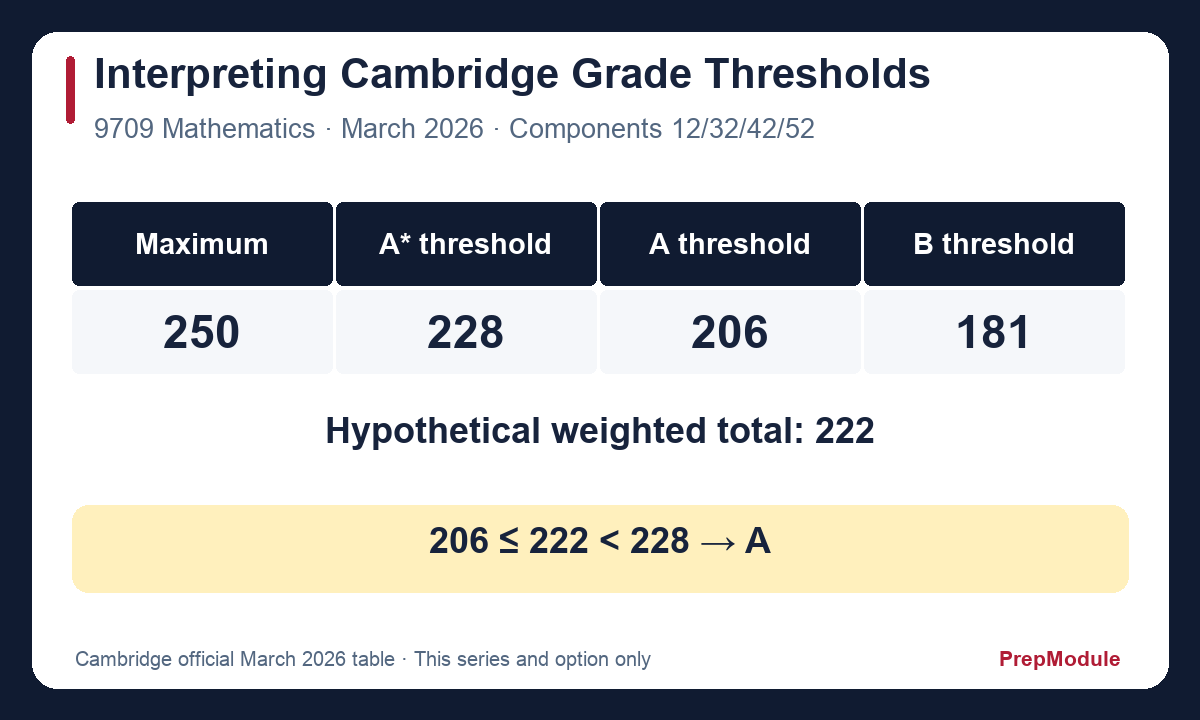
Below are the official grade boundaries for combinations where all individual components 12, 32, 42, and 52 were taken in the actual Cambridge International Mathematics (9709) March 2026 session.
| March 2026 9709 | Weighted total / 250 |
|---|---|
| A* | 228 or higher |
| A | 206 ~ 227 |
| B | 181 ~ 205 |
| C | 148 ~ 180 |
| D | 115 ~ 147 |
| E | 83 ~ 114 |
For example, in this combination, a student with a final weighted total of 222 points corresponds to an A. Reaching 228 points results in an A*. The boundaries in this example apply only to that specific series and combination. Even within the same March 2026 9709, the values differ for the 12, 32, 52, and 62 combinations: A* 227 and A 204. These are previously released standards, not a confirmed table that can predict the criteria for the next round.
Do you need to get an A* on every individual test paper to receive an A*?
Cambridge does not award A* grades for individual components. Instead, it determines whether the overall qualification meets the A* criteria. While scores for individual exams, such as Mathematics Paper 1 and Paper 3, can be managed separately, the calculation does not assume that one must receive an A* for every single Paper.
The A* boundary is established based on the A and B boundaries and maximum scores of the corresponding combination. You should not understand this as a rule like Edexcel IAL where the A2 UMS 90% rule applies universally to all subjects.
PUM 90 is not Raw Mark 90%
PUM is achievement information on a scale of 0 to 100 that appears alongside grades in the Statement of Results, depending on the country. It shows where the student is positioned on the grade boundary based on the publicly released grade threshold.
| Cambridge International A Level Grades | PUM Range |
|---|---|
| A* | 90–100 |
| A | 80–89 |
| B | 70–79 |
| C | 60–69 |
| D | 50–59 |
| E | 40–49 |
A PUM of 90 indicates that it is the starting point for an A* grade, not that it represents the 90th percentile of the raw score. Since there is no A* in AS, the PUM range for an A grade is 80–100. The PUM is displayed on the results table for the region provided, but it is not displayed separately on the certificate. You cannot calculate the final grade by adding PUMs by Unit, as is done with Edexcel.
Carry-forwarding AS Results to A Level
Cambridge allows you to carry forward your entire AS exam results to your A Level, provided the syllabus permits staged assessment. Official guidelines state that you can carry forward AS results up to twice within 13 months. This is not a method of arbitrarily selecting only parts of previous exam papers, but rather reflecting the entire AS result in accordance with the registration regulations.
For example, if a student who completed AS in the June session is taking the A Level exam in the following June, they will check the staged route and entry option with the school Exams Officer. If you have two past AS scores, you should not simply choose the exam with the higher raw mark. You may need to identify the result with the higher relative achievement based on the grade thresholds and PUMs of both sessions.
The sequence for setting target grades based on the score report
First, check the syllabus code, exam session, and entry option. Then, find the corresponding component combination and weighting factor to calculate the weighted mark and compare it to the publicly available grade threshold. Past data should be used as a reference to check current scores, but should not be considered as the final grade boundary for future sessions.
By recording which papers or units the student loses points on and preparing using the latest official syllabus and examiner report from the testing agency, you can determine the scope of study more accurately.
A Hypothetical Example of Calculating Cambridge’s Weighted Mark
Let’s assume that a Cambridge A Level syllabus has three components with maximum raw marks of 60, 40, and 50, respectively, and weighting factors of 1, 1.5, and 1. If a student receives 42, 30, and 40 points, the total raw mark is 112 points. However, if the factors specified by the syllabus are applied, 42×1+30×1.5+40×1=127 points, and the weighted maximum is 60+60+50=170. Compare this weighted mark with the corresponding combination of publicly available grade boundary points. These figures are merely examples to aid understanding and are not the actual weighting factors or grade boundaries of the subject.
If the hypothetical A grade boundary is 120 points and the A* is 140 points, the student above is in a situation where they receive an A. Even if the total score is the same, taking a different combination of components or participating in a different exam session does not necessarily guarantee the same result. Cambridge releases the grade threshold after the evaluation for each exam session is complete, so figures from previous sessions are not used as the final standard for the current session.
The Meaning of Three Types of Information on a Cambridge Scorecard
The final grade is the achievement level for the official qualification; the raw mark is the score received directly on the questions; and the PUM is a relative achievement scale provided in some countries. For example, if the PUM is 85, it does not mean that the student answered 85% of the actual exam questions correctly. It is a separate value indicating the student's position within the grade threshold. When a student asks about their score, it is advisable to distinguish whether they want to check only the grade, the PUM, or inquire with the school about the actual scores for each component.
Exams may have a variant attached after the Paper number. Even for the same subject, the component code may differ depending on the region and session where the student took the exam. Make it a habit to record the qualification, syllabus code, exam series, entry option, and component code listed on your score report, and compare them against the official threshold table for that session released by Cambridge.
A detailed look at how to carry forward AS results
In the Staged route, the total results of previous AS exams and the results of the current A2 component can be combined. Cambridge specifies the period and entry options for combining identical AS results. You must first verify how the student is enrolled, and even if you have two AS score reports, you cannot arbitrarily mix the highest scores from different papers to calculate the A Level grade.
For example, in two hypothetical AS exam sessions, if the first exam raw mark is 72 and the PUM for that year is 84, and the second exam raw mark is 75 and the PUM is 80, you cannot conclude that the achievement from the second exam, which has a higher raw mark, is necessarily higher. Check with an Exams Officer to see if the actual enrollment conditions allow for both scores, if Cambridge's best-of-both option is available, and which AS results the school should carry over. Cambridge's official carry-forward guidelines help identify exceptions specific to each subject and enrollment method.
Comparison Items to Avoid Confusion Between Edexcel and Cambridge
Since both examination bodies operate International A Level courses, students sometimes assume they have syllabuses with similar names. However, there are differences between Edexcel IAL's method of summing Unit-by-Unit UMS and Cambridge's method of applying component combinations and grade thresholds. You cannot apply Edexcel's standard A* formula directly to Cambridge exam papers, nor should you consider the PUM used by Cambridge to be the same unit as Edexcel's UMS.
From the moment you register for a course at school, verify exactly which examination body the subject belongs to. When obtaining past exam papers and mark schemes, search based on the Cambridge International AS & A Level subject code and exam session number. Subsequently, if you record how your school exam results have changed compared to the past, the points lost by question type, and how the actual component weights differ, it will make preparing for the entire A Level easier. Students with a conditional offer from a target university must verify the required final qualification grade separately from estimating their total score.
Planning classes based on Cambridge A-Level grades
Checking the transcript and subject codes
Verify whether AS was taken first, whether the entire A-Level is being taken at once, and which components and options were selected. Distinguish the items on the official transcript to avoid confusing the Grade Threshold table with PUM notation.
Analyzing weak components
Based on actual answers or assessment feedback received from the school, identify areas where the student can improve, such as calculations, long-form questions, and interpretation of practical materials. Accurate confirmation from the school's exam administrator is required regarding AS carry-forward eligibility and timing.
Focusing on necessary exams
In PrepModule, you can discuss classes needed for specific components, units, and practice answers based on the Cambridge syllabus. It is also possible to review A-Level required subjects by major through admissions counseling.
Do not confuse Cambridge and Edexcel; check the correct syllabus and test session first.
Official resources
Cambridge International A-Level Class Inquiry
PrepModule offers international-school tutoring, SAT and TOEFL preparation, competition preparation, and U.S. college admissions counseling tailored to each student. Our tutors include an MIT computer science major and a research and writing tutor pursuing a PhD in Political Science at LSE. We check tutor availability and scheduling for your requested subject.
Instead of packages that include unnecessary classes, you can select subjects and class durations based on the student's situation.
Please let us know which level you are at (AS or A Level) and what areas need improvement in your syllabus and transcript. We will identify the appropriate course subjects for you.
