Pearson Edexcel International A-Level grading: UMS, cash-in and A*
Understand Edexcel IAL raw marks, UMS, unit scores, cash-in and A* thresholds, with worked hypothetical examples and exam planning.
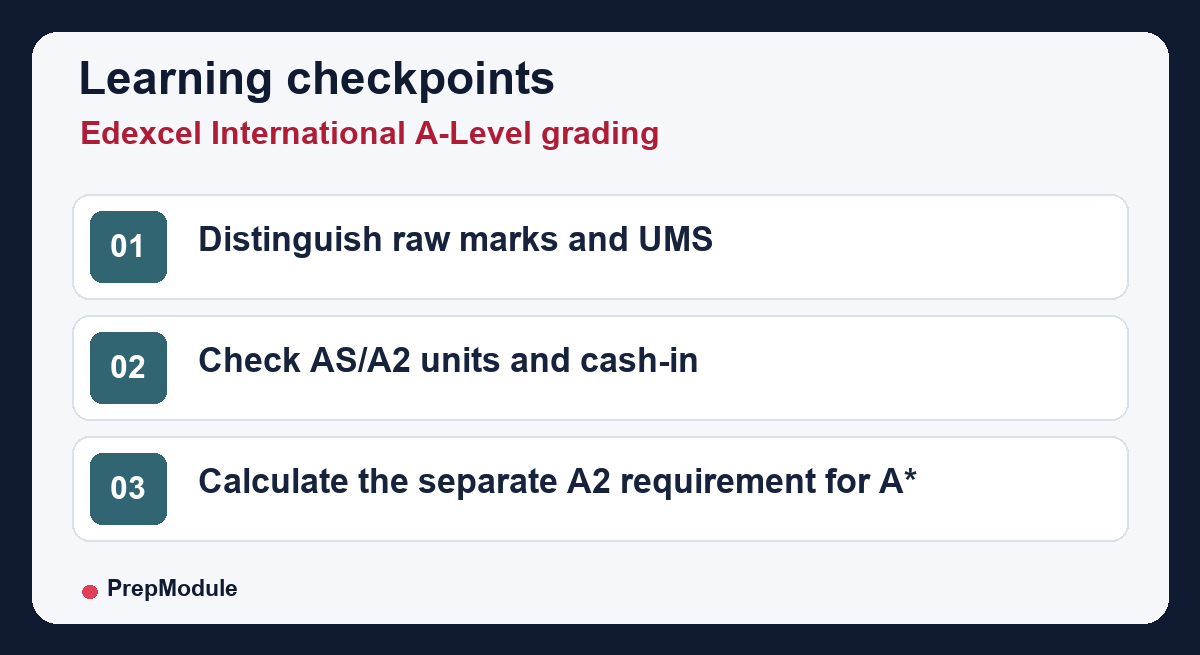
When you first look at an Edexcel A-Level report card, you may be confused by the terms Raw Mark, UMS, Unit, and Cash-in. The score graded by the school may look different from the score displayed on the results sheet. If you assume that the score calculation method is the same as Cambridge International A-Level, you may set your target grade incorrectly.
Today, we will examine how grades are calculated based on the Pearson Edexcel International Advanced Level (IAL). Since the evaluation method differs from the UK domestic GCE A-Level and some exceptions, please check the qualification listed on the report card first.
Raw Mark → Unit UMS → UMS Sum → Cash-in Grade
Raw Mark and UMS are not the same number
Raw Mark is the actual score obtained from the exam paper. The Uniform Mark Scale (UMS) is a score calculated by converting raw marks to a common scale, taking into account that the difficulty of the questions may vary by exam session. Therefore, even with the same raw mark, the UMS may differ across different exam sessions. You can check the converted value by specifying the exam session and Unit in Pearson's official mark converter.
Most IAL subjects are modular qualifications divided into multiple Units. Typically, you study Units from International AS and International A2 and can take the exam in multiple sessions as needed. The key point is that the qualification grade is calculated by summing the UMS scores of each Unit, rather than simply adding up the Raw Marks. There may be exceptions, such as Law, so you must check the relevant subject specifications.
A grade criteria for 4-unit IAL and 6-unit IAL
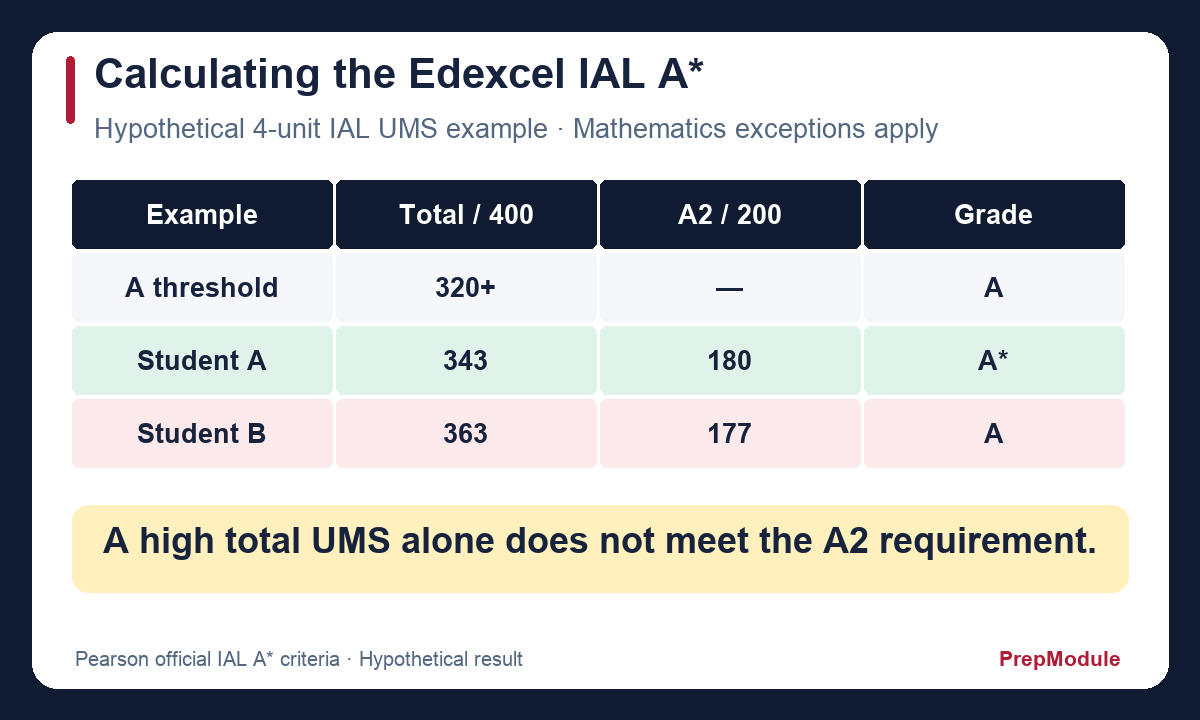
According to Pearson, the maximum UMS sum for a standard 4-unit IAL is 400 points, and for a 6-unit IAL it is 600 points; the total threshold for an A grade is 320 and 480 UMS, respectively. Since the maximum UMS may vary by Unit, please check the Unit ratios and sum the total scores.
| General Structure | 4-unit IAL | 6-unit IAL |
|---|---|---|
| Maximum Total UMS | 400 | 600 |
| A Overall Criteria | 320 | 480 |
| General A* A2 Criteria | 180 / 200 | 270 / 300 |
Note: International A Level Mathematics is subject to separate A* criteria, so it is explained separately below. For accurate official grading criteria, it is best to check the subject-specific specifications and Pearson's result guide.
4-unit example: Even if you get an A overall, it may not be an A*
Assuming AS Unit scores of 85 and 78 for a 4-unit subject and A2 Unit scores of 92 and 88 UMS, the total is 343/400 and the A2 total is 180/200. Since it simultaneously satisfies the A overall criterion of 320 and the A2 criterion of 180, it is an A* under the general criteria.
Assuming another student received 94 and 92 points in AS and 88 and 89 points in A2, the total is a much higher 363 points, but the A2 total is 177 points. Even though the overall A standard is exceeded, the A2 requirement of 180 points is not met, so the calculation results in an A rather than an A*.
| Example | Total UMS | A2 UMS | Grade |
|---|---|---|---|
| Student A | 343 / 400 | 180 / 200 | A* |
| Student B | 363 / 400 | 177 / 200 | A |
Both examples are hypothetical UMS for illustrative purposes and are not raw mark examples.
Edexcel IAL Mathematics A* considers P3 and P4 separately
For Mathematics, you must receive a minimum of 480/600 UMS across all International A Levels, and the sum of P3 (Pure Mathematics 3) and P4 (Pure Mathematics 4) must be at least 180/200 UMS. This does not mean that P3 and P4 must each receive exactly 90 points.
For example, if the total is 492 UMS, with P3=92 and P4=88, the sum is 180, satisfying both conditions. Conversely, even with a total of 520 UMS, if P3=87 and P4=89, the sum is 176, so it does not satisfy the A* condition. Since Further Mathematics and Additional Further Mathematics are separate qualifications, please check with your school's Exams Officer for the appropriate Unit/Cash-in combination.
What is the Cash-in procedure?
There is a distinction between taking all Unit exams and receiving the full qualification grade. Cash-in is the procedure for requesting the full grade for the relevant subject qualification. You can check if the Unit code on the transcript starts with W, the International AS cash-in code starts with X, and the International A Level cash-in code starts with Y.
If you have taken all the exams but are not receiving an overall grade, please check with your school's Exams Officer to see if the file is being read incorrectly or if a Cash-in application has been submitted. It is also important to ensure you are registered under the same UCI (Unique Candidate Identifier) when retaking the exam. Pearson explains that for the same UCI, the better result of the two most recent attempts is generally used for the calculation. Since Cash-in can fix Unit assignments in the Mathematics series, you must verify that the application is correct.
How should I change my exam preparation?
If your goal is an A*, do not just review the entire UMS; instead, record the actual UMS for A2 or Mathematics P3/P4 separately. Check the raw-to-UMS conversion for each exam session using an official converter, and reviewing by distinguishing the concepts and question types of your weaker Units will make it clear which areas you should spend more time on. It is better to check your school's exam schedule and qualification combinations first rather than blindly re-examining a single Unit.
For 6-unit subjects, the total UMS and A2 portions are calculated separately.
Let's assume that for a standard 6-unit IAL subject, the maximum UMS for each unit is 100 points. If the UMS for AS Units is 82, 85, and 85 points, and for A2 Units is 93, 91, and 88 points, the AS total is 252 points, the A2 total is 272 points, and the total sum is 524/600. If the standard 6-unit A* conditions requiring a total of 480 or higher and A2 of 270/300 or higher are applied to this hypothetical subject, both conditions are met. You must verify in the specification whether there are any exceptions to the maximum UMS or A* formulas per unit for the actual subject. Mathematics is a representative exception that is calculated separately using the P3 and P4 conditions discussed earlier.
Assuming another student's AS results are 96, 98, and 98, and their A2 results are 89, 90, and 89, their total is higher at 560, but their A2 total is 268. This falls short of the standard A2 270/300 threshold by 2 points. In this case, rather than concluding that you must restudy all units at school, you should first verify which units caused the score discrepancy and how it would actually be reflected in the final grade calculation if you were to retake the exam.
Record your grades by separating Raw Mark, UMS, and Grade.
When organizing your transcript, instead of just writing down the subject name, it is recommended to record the Unit code, exam session, maximum raw mark for that unit, the raw mark received, maximum UMS, and actual UMS in separate columns. Since the transcript provided by the school separates grades and codes, please be careful not to mix scores from unofficial mock exams with official exam results.
For example, you cannot determine how many points are short of an A* based solely on the information that you received a score of 65 on the exam paper. This is because the conversion result varies depending on whether the exam paper is scored out of 75 or 90 points, and which session and component the raw 65 score belongs to. You can verify the actual UMS by utilizing Pearson’s official raw-to-UMS converter and the grade boundary of the subject. It is advisable not to decide whether to retake the exam by directly comparing raw marks from different sessions.
Completion of International AS and the overall IAL grade are separate.
You can verify the overall International AS grade by completing the units required to form the International AS Level and cashing in as an AS qualification. The structure involves completing the overall IAL qualification by adding A2 units afterward. You must verify that the school has accurately registered the units and cash-in codes necessary for the student's overall IAL grade. In particular, if a student transfers to a different school or changes test centers, please ask the Exams Officer to ensure that necessary information, such as the UCI from previous scores, is accurately maintained.
In the mathematics track, even if there are common units available, you should not assume that they can be used for multiple Mathematics qualifications. You must review which qualification you applied for, which units were assigned, and whether this affects the combination of Further Mathematics. You need to consult Pearson’s relevant qualification guidelines and verify this with your school's registration officer.
A study plan to determine if retaking the exam is necessary
First, check the official admission requirements of your target university to see if all subjects require an A or A*, or if there are separate requirements for specific subjects. Then, record the areas where you are currently lacking at UMS. By examining the types of calculation mistakes made in past exams, answer wording, problem-solving speed, and time constraints unit by unit, you can determine a specific direction for your studies.
For example, if a student is struggling with the function problems in P3 and the differential equations in P4, it may be more helpful to identify the necessary concepts for each problem and solve new examples, rather than repeating the entire math curriculum from the beginning. When considering retaking the exam, examine the school's registration deadline, the exam session, the subject recognition method, and the impact on your current courses. It is advisable to make decisions based on your actual current grades and remaining schedule, rather than a plan based on the assumption that your score will improve.
How to Create an Actual Study Plan Using an Edexcel IAL Scorecard
Checking the Type of Exam Result
Identify the unit code, raw mark, UMS, and cash-in status in the recent Statement of Results. Since the same score of 70 can have different meanings depending on whether it is a 70 raw mark or a UMS, first check which result the student is seeing.
Calculate Official Requirements If Aiming for an A*
Check the full UMS and higher-level unit requirements specified in the subject-specific qualification specification. Based on the subject structure and exam timing, organize which units need improvement and how to discuss retaking the exam with the school's exam administrator.
Personalized Instruction by Unit
Based on the Pearson Edexcel exam, identify your current class progress and weak areas to selectively inquire about classes for specific unit preparation or calculation and descriptive problem-solving. Final processing of cash-in, exam registration, and official score determination follow the school and Pearson guidelines.
For Edexcel IAL, it is important to check the total UMS sum and the additional criteria for A* together.
Official resources
Inquiry about Edexcel IAL Subject-Specific Classes
PrepModule offers international-school tutoring, SAT and TOEFL preparation, competition preparation, and U.S. college admissions counseling tailored to each student. Our tutors include an MIT computer science major and a research and writing tutor pursuing a PhD in Political Science at LSE. We check tutor availability and scheduling for your requested subject.
Instead of packages that include unnecessary classes, you can select subjects and class durations based on the student's situation.
Please provide the subjects and units the student is currently taking, recent UMS scores, and exam schedule. We can consult on classes tailored to the school's exam format.
