AP Microeconomics vs Macroeconomics: choosing a course and study sequence
Distinguish individual markets from economy-wide models and practise reading economic graphs.
When looking at AP Economics courses, you may wonder whether to study Microeconomics or Macroeconomics first. Although the names are similar, these courses examine the same economic situation on different scales.
Distinguishing Between Market and Global Economic Perspectives
Microeconomics and Macroeconomics focus on different subjects.
Microeconomics studies choices made by individual consumers, firms, and markets. Macroeconomics examines production, prices, employment, and policies for the entire economy.
The order of learning may vary depending on the school's teaching methods and student interests.
Are rising product prices and inflation the same issue?
If the price of a specific product has risen due to increased production costs, one can examine the supply and demand of individual markets. On the other hand, if prices for the entire economy are constantly changing, analysis from a different perspective, such as aggregate demand and aggregate supply, is required.
The ability to distinguish which economic model is appropriate is important.
When studying graphs, try to organize the reasons behind them as well.
Explain the cause of the change, the shifting curve, and the impact on price or production volume in order. Studying while understanding the reasons behind economic phenomena, rather than just memorizing graphs, makes it easier to handle new problems.
An example of viewing firm costs in microeconomics
Assuming a hypothetical store has a total cost of $800 when selling 100 items and $850 when selling 110 items, the cost of producing an additional 10 items is $50. The average cost change per additional unit is $5, which serves as a starting point for understanding the concept of marginal cost. When a firm determines its production volume, it must also consider the additional revenue generated from increasing production.
Macroeconomics examines indicators of the entire national economy
A decrease in the inflation rate does not necessarily mean that the price level itself has fallen. For example, if a hypothetical price index changes from 100 to 110 and then to 115, prices continue to rise, but the growth rate is approximately 4.5%, which is lower than the previous 10%. By distinguishing these indicator concepts and connecting the overall supply and demand graphs with policy effects, you can read Macroeconomics problems much more clearly.
Choose the classes you need, from introduction to economics to AP exam preparation
Understanding the student's economics background
We use simple examples to verify your understanding of supply and demand and opportunity cost, as well as your ability to explain the difference between inflation and economic growth.
Practice with key diagrams by subject
Micro examines the choices of market participants, while Macro examines variables and policies for the entire economy. You can inquire about a class where you read a problem, select an appropriate graph, and explain the direction of change and the reasons using both verbal explanations and formulas.
If you are studying both subjects together
We can separate common concepts from different graphs for learning and discuss unit-by-unit lessons tailored to your school's exam schedule.
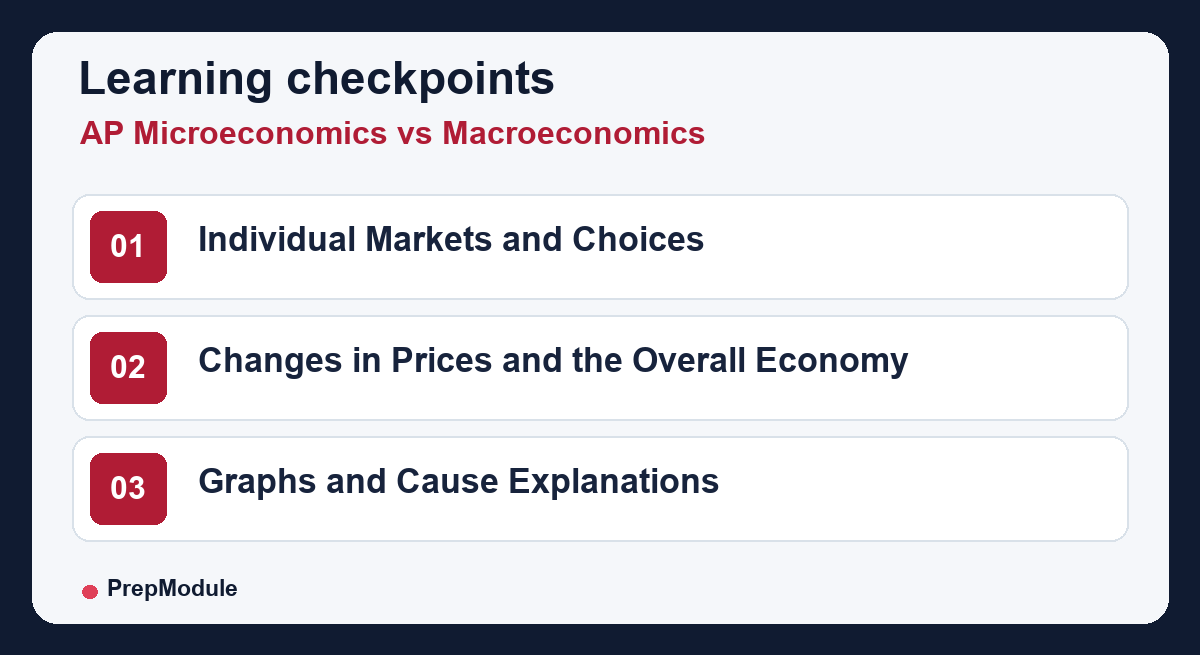
Graphs and Cause Explanations
Official resources
Inquiry about AP Micro/Macro classes
PrepModule supports the learning needs of each student, ranging from international school curriculum to U.S. university admissions. We have teachers specializing in various fields, including a tutor in politics, research, and academic writing who is a PhD candidate in Political Science at LSE and an Oxford researcher.
You are not bound by long-term packages; you can select the subjects and writing areas you need individually and apply for as many times as you desire.
If you send us the parts you are struggling with regarding your currently selected Economics subject, graphs, calculations, or FRQs, we will provide consultation on the Economics classes for that course.
