AP Biology: studying data interpretation and free-response questions
Practise interpreting data and explaining relationships between biological structures and functions.
AP Biology contains many biological terms and concepts found in textbooks. However, in FRQs, you will encounter not only questions requiring you to simply write definitions but also problems where you must analyze given data to determine which explanation is valid.
Explaining Biology Concepts Using Data
Explain why certain phenomena occur.
When studying cell structure or the movement of substances, examine the names of each process and how they affect biological functions. It is also helpful to organize interconnected concepts using diagrams.
This is because even if an exam presents unfamiliar situations, you can find the answer by utilizing the concepts you have learned.
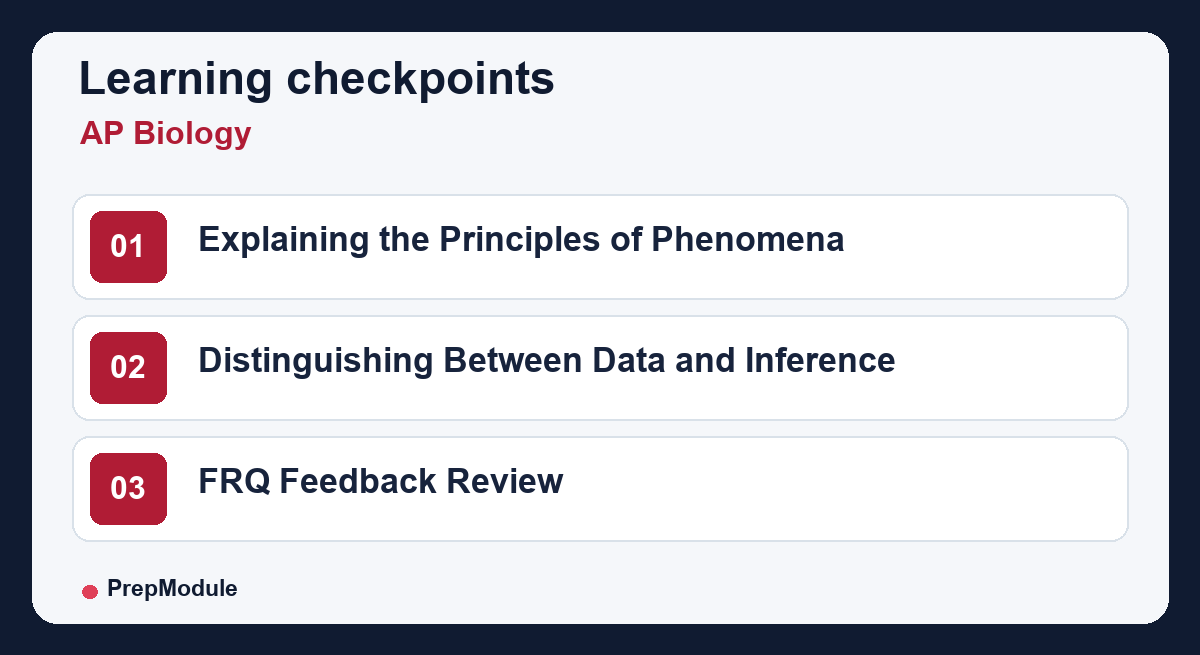
Distinguish between facts presented in the data and possible explanations.
Assuming results measured under two conditions are presented, you must first explain which condition yielded the higher value. Then, utilize the biological concepts you have learned to provide a possible explanation for the difference.
It is also necessary to practice not making definitive conclusions about results that the data does not show.
FRQ feedback serves as a hint for the next problem.
Refer to the publicly available official practice questions and grading guidelines to identify any lacking evidence in your answers. By applying similar content to other graphs or questions, you will be able to explain things without simply memorizing the sentences in the model answers.
In what order should you read data interpretation type FRQs?
Let's take hypothetical ecological data as an example and assume that the number of plant species observed in two regions is 12 and 18, respectively. First, you must accurately compare the difference between the two values and verify whether the survey area or period is the same. If the survey areas differ, there may be limitations in judging diversity based solely on these two numbers. Write down the trends shown in the data and then connect those trends to related biological concepts.
Expressions to check when evaluating answers
Identify, describe, explain, and justify require different depths of answers. If asked to explain, do not just write the name of the concept corresponding to the answer; connect it to why that result occurred. Compare the FRQs and grading criteria published by the College Board to determine what evidence is required. It is recommended to review concept explanations and graph reading together, aligned with the actual school exams and course scope.
PrepModule Lesson Direction for Preparing for AP Biology FRQ
Checking Curriculum Concepts
Verify whether you accurately understand concepts such as cell structure, genetics, and energy transfer from recently solved problems. Even if you know the terminology, you may get stuck on which concept to apply to the data in the problem.
Preparing for Data-Type Questions
Practice distinguishing between actual observed results and explanations of those results in graphs and tables, and writing answers that connect claims, numerical evidence, and curriculum concepts. You can also check the scoring criteria using publicly available College Board scoring examples.
Subject Supplementation by Exam Schedule
If your school has not yet finished the curriculum, you can request separate practice starting with the necessary chapters; if you have already studied the concepts, you can request separate practice for Multiple Choice and FRQ time management and English answer writing.
FRQ Feedback Review
Official resources
Inquiry regarding AP Biology Concepts and FRQ classes
PrepModule offers international-school tutoring, SAT and TOEFL preparation, competition preparation, and U.S. college admissions counseling tailored to each student. Our tutors include an MIT computer science major and a research and writing tutor pursuing a PhD in Political Science at LSE. We check tutor availability and scheduling for your requested subject.
Instead of packages that include unnecessary classes, you can select subjects and class durations based on the student's situation.
If you let us know your current chapters (e.g., Cells, Genetics, Ecology) and the feedback you are receiving on FRQs, we will identify a suitable teacher and schedule for your Biology classes.
