IB Biology HL and SL: from memorizing terminology to writing better answers
Practice explaining biological structures and relationships, interpreting data and constructing evidence-based written answers.
IB Biology has many terms to memorize. However, even students who have accurately memorized the diagrams in the textbook may miss the key point while writing long answers when faced with a question asking to explain a function on the exam.
When preparing for the exam, a step beyond memorization is necessary.
You Must Be Able to Explain the Relationship Between Structure and Function
When learning about structure, examine its function as well.
For example, when studying the structure of a cell membrane, you must consider how substances can pass through the membrane along with the names of its components. Ask yourself what would happen if that structure did not exist.
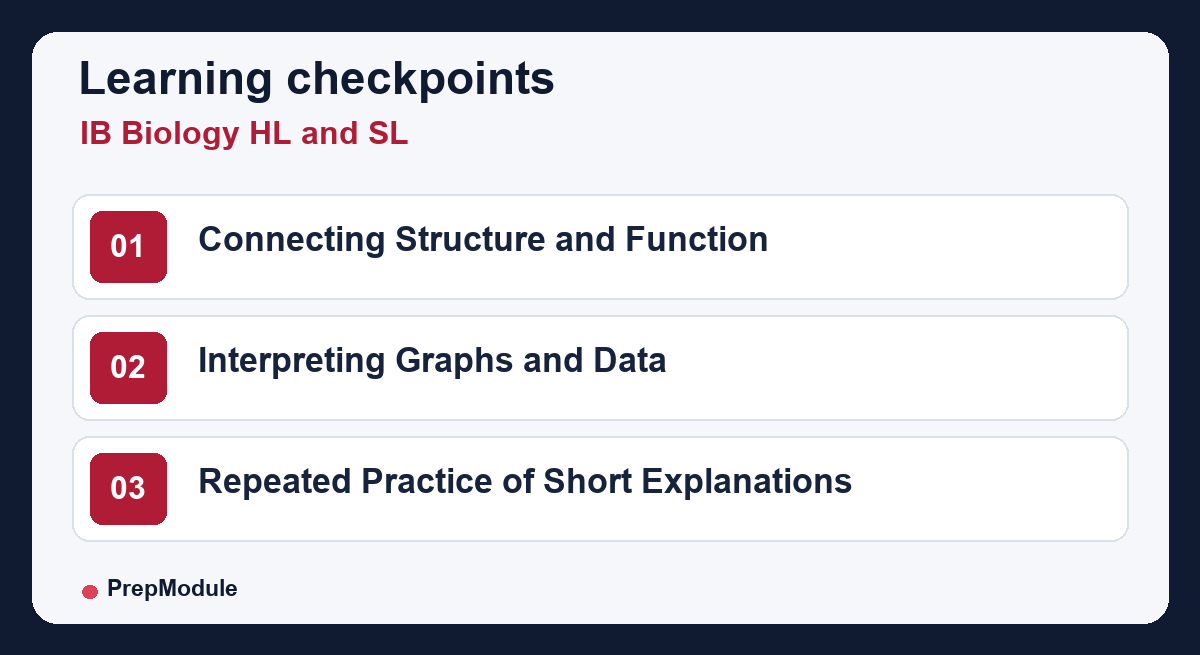
Connecting cause and effect rather than just memorizing a single term allows you to apply the biological concepts you have learned to new situations.
In data interpretation problems, read the graph first.
Let's assume you are given a graph of biological characteristics observed under two conditions. You must first explain under which condition the value increased and where the range of difference lies.
Then, connect the possible reasons to biological concepts. Not making definitive conclusions about causes that cannot be determined solely from the graph is also an important part of a good answer.
How to Prepare Multiple Short Explanations
Close your textbook and try to explain why a specific structure is important in about three sentences. If there are any inaccurate terms, look them up again, and a few days later, explain the same concept using a different diagram.
Even if you are preparing for HL or SL, checking how learned concepts connect in this way can reduce the burden of rote memorization right before the exam.
Common Misses in Graph Interpretation Questions
Let's assume that in hypothetical photosynthesis data, oxygen production increases at low light intensities, but the graph flattens out after a certain level. First, state the trend shown in the data, and then explain the possibility that other factors acted as limiting factors. If you cannot determine exactly which factor was the limiting factor based solely on the graph, you must distinguish it in that way. You need to practice utilizing biological concepts you know based on the data, but avoid making definitive conclusions about unobserved facts.
How to Study for Essay-Type Answers
When organizing biological terms, do not just write down definitions; try explaining them briefly in the order of structure → function → observed results. For example, the selective permeability of a cell membrane is linked to the function of regulating the movement of substances. It is easier to grasp the direction of your answer if you are aware of the difference between "Describe"—describes the characteristics of data—and "Explain"—connects reasons with mechanisms. Check the evaluation criteria in the subject guide and feedback received from the school, and revise your answers paragraph by paragraph.
A Class Connecting Biology Terms to Actual Answers
Concept Diagnosis
Check if students can explain concepts learned in school, such as cell composition, the role of enzymes, and genetic information, in their own words. Since simple definitions may differ from the ability to interpret graphs and data, it is recommended to start by analyzing the types of incorrect answers found in recent exams.
Practice with Evaluation-Type Questions
First, identify the axes, units, and direction of change of the graph; then, explain the basis using numerical data and connect it to relevant subject concepts. You can practice changing the scope and structure of your answers according to command terms such as Compare, Explain, and Evaluate.
Semester Review Plan
If you provide your HL/SL school curriculum progress and in-school exam schedule, you can inquire about necessary classes, such as unit-by-unit theory summaries, English descriptive answer practice, or feedback on student assignments.
Repeated Practice of Short Explanations
Official resources
Inquiry about IB Biology Classes
PrepModule offers international-school tutoring, SAT and TOEFL preparation, competition preparation, and U.S. college admissions counseling tailored to each student. Our tutors include an MIT computer science major and a research and writing tutor pursuing a PhD in Political Science at LSE. We check tutor availability and scheduling for your requested subject.
Instead of packages that include unnecessary classes, you can select subjects and class durations based on the student's situation.
If you let us know which part—such as memorizing terms, interpreting data, or writing descriptive answers—is difficult, we will check the schedule and find a Biology tutor that matches the student's school progress.
