Biology vs Biomedical Engineering vs Pre-Med: high-school preparation
Compare Biology, Biomedical Engineering and Pre-Med pathways, relevant school subjects, ethical research literacy and high-school activities.
If your child is interested in biology or medicine, they might ask, "Do I need to major in Biology at a U.S. university to get into medical school?" While Biology, Biomedical Engineering (BME), Neuroscience, and Public Health are related fields, the content and goals taught at the university levels differ from one another.
How do Biology and Biomedical Engineering differ?
Biology is the discipline of understanding life phenomena and living organisms. BME is a discipline that utilizes engineering and mathematics to solve problems in the medical and life sciences fields; it places significant emphasis on engineering design and quantitative analysis, in addition to basic science. Public Health examines the environment, institutions, accessibility, and statistics surrounding health at the collective level.
What is Pre-med?
In the United States, Pre-med typically refers to the process and requirements for preparing to apply to medical school; it is not necessarily the name of a specific undergraduate major. Official AAMC guidelines also explain that students should fulfill the prerequisite courses for their target medical school rather than requiring a specific undergraduate major. Since requirements vary by university and medical school, international students must individually verify their eligibility, finances, and pathways to admission.
Rather than choosing a major solely because it is related to medical school, first examine what you are interested in: science itself, engineering solutions, or public health.
Recommended Curriculum for High School Students
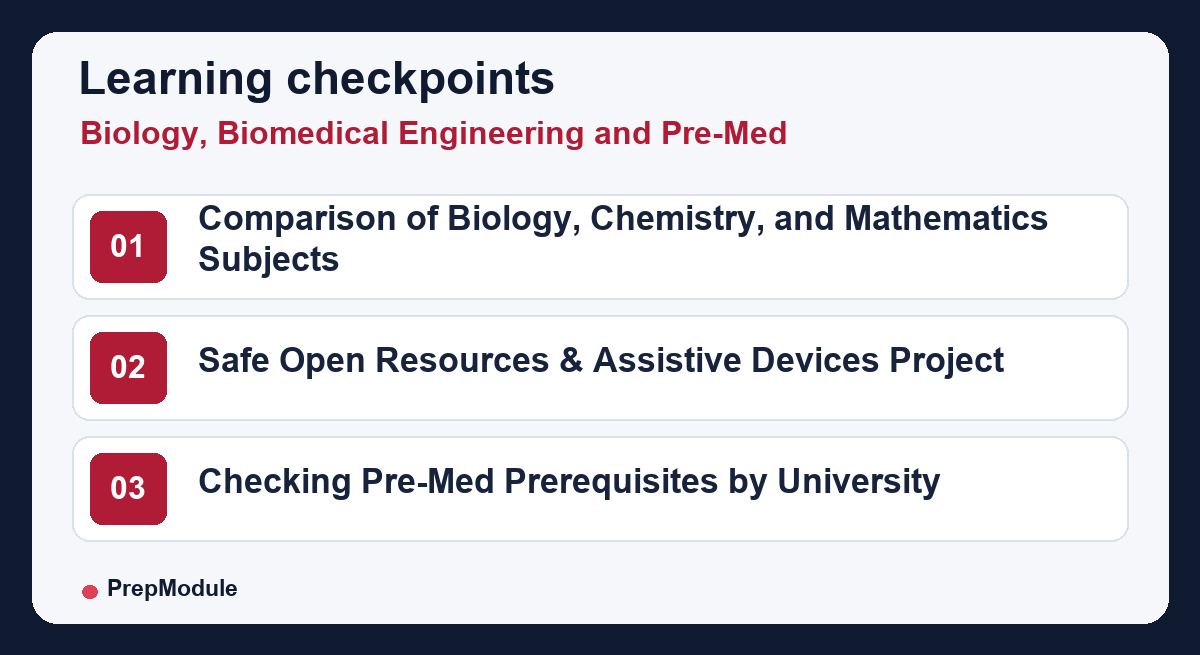
Studying Mathematics and Physics alongside Biology and Chemistry is beneficial for comparing various biomedical fields. This does not mean you must take IB Biology, IB Chemistry, AP Biology, AP Chemistry, and A-Level courses. You should align the combinations possible within your curriculum with the subjects required by your target school. If you are considering BME, also look into whether you have an interest in Epidemiology and Calculus.
Examples of Safe and Meaningful Activities
If a student is interested in the field of public health, they can read regional and yearly aggregate statistics or data on access to health services released by the government, and compare the definitions and measurement ranges of graphs. There is absolutely no need to collect personal health information or make arbitrary diagnoses. You may also examine how statistics are conveyed by comparing publicly available case studies with scientific communication texts.
If you are interested in BME, try observing general accessibility issues in school facilities or designing paper or digital models of non-medical tools with modified shapes to make them easier to grasp. This involves establishing basic user requirements and design conditions with a teacher and documenting areas for improvement. This is not a project intended to use the material as a medical device or to test it on humans.
Are research papers or research camps absolutely necessary?
No, they are not. You can start by consistently reading academic texts in your field of interest and summarizing their content and limitations. High school students must not attempt dangerous experiments or participant studies without formal supervision and approval from a research institution. If you intend to submit to a competition, it is better to check the relevant institution's research ethics regulations first. Focus on activities where you can understand and explain questions on your own.
Shall we compare the subjects you will learn after entering college?
The Biology major covers the fundamental concepts that constitute life phenomena, as well as various questions regarding ecology, cells, genetics, and biodiversity. Biomedical Engineering is an engineering field based on mathematics and physics that understands the principles of biological and medical technologies and applies them to design. Pre-med is not the name of a specific department, but rather a pathway prepared with medical school in mind; therefore, you must check the official prerequisite courses and admission requirements for each university and medical school.
Even if you share the same biomedical field, whether you find reading biological questions interesting, mathematical models and engineering explanations more engaging, or have a broad interest in people and health may vary. Read the descriptions of introductory courses for each major and find classes that the student genuinely finds interesting.
Safe Inquiry Examples Possible in School
If a student is interested in ecology, they can compare regional species diversity data released by public institutions and summarize the differences in interpretation based on observation periods or survey scopes. If you are interested in biological movements, you can create concept explanation materials by connecting joints and basic mechanics based on illustrations in textbooks. There is no need to collect human health or personal information, or conduct experiments that require permission.
A good outcome is not merely a list of difficult terms, but a record that shows what questions the student was interested in and what public resources and textbook concepts were used to explain them. It is recommended to include drawings, tables, short presentations, and a list of references.
Balancing Activities and Course Selection
First, identify the subjects required by the student's desired major among Biology, Chemistry, Mathematics, and Physics. Thoroughly preparing for descriptive questions and data interpretation in school science classes is an important foundation. If a student has not yet decided on a career path, it is a good idea to start by encountering various questions within the regular curriculum and engaging in safe and accessible activities such as science clubs, reading, and interpreting public resources. For actual medical school applications or research participation, you must verify the official qualifications and regulations of the relevant institution, and external research or papers do not guarantee university acceptance.
When considering a biomedical track, separate your coursework from your career preparation
Check major differences and university requirements
Compare Biology, Biomedical Engineering, and university pre-med courses to see which area the student wishes to develop: life science concepts, math and engineering problems, or an interest in human health and public health. Pre-med does not necessarily correspond to a single undergraduate major name.
Safe learning and inquiry
Coursework: Begin with understanding the basics of life science and math/chemistry, and with activities that involve interpreting non-sensitive health education statistics from public institutions or science reading materials. You can develop reading, evidence judgment, and data interpretation skills without engaging in medical practice or dangerous experiments.
Admissions & Class Connection
You can consult with former admissions officers regarding school subject combinations and university-specific requirements, and you can inquire specifically about areas requiring supplementary instruction in Biology, Chemistry, and Math, as well as material reading and academic writing.
Understanding the differences between Biology, BME, and Public Health first allows you to select subjects and activities that suit you, even if you share the same interest in life sciences.
Official resources
Biology, Biomedical Engineering, and Pre-med Career Counseling
At PrepModule, you can consult U.S. university admissions experts, including former Harvard College admissions officers. You can also discuss coursework and extracurricular preparation with subject tutors, including an MIT computer science major and a research and writing tutor pursuing a PhD in Political Science at LSE.
You can request admissions counseling on a per-session basis, and afterward, you can choose as many necessary classes and activity preparations as you like.
Please let us know your major of interest, the Biology, Chemistry, and Math courses at your school, and the activities you are currently participating in. We can discuss subject selection and necessary classes that take into account the differences between each major.
