IB Chemistry HL and SL: mastering chemical calculations and concepts
Build IB Chemistry HL and SL skills through chemical equations, mole calculations and concept explanation.
When you first start learning IB Chemistry, you may find yourself stuck on which numerical values to use in exam questions, even though you have memorized the reaction equations in the textbook. If you studied chemistry thinking of it as a subject of simple memorization, you may find calculation problems particularly difficult.
Connecting the Meaning of Reaction Equations and Calculations
Why You Look at the Reaction Equation First in Chemical Calculations
To calculate moles or concentration in chemistry, you must know which substance changes into what. Since the coefficients in a reaction equation represent the quantitative relationship between substances, if you do not properly understand this, the answer may not be correct even if you calculate the numbers.
It is recommended to check the scope of HL and SL based on your current IB Chemistry guide and school curriculum progress. Identifying a student's weaknesses and reinforcing the basics is important for both levels.
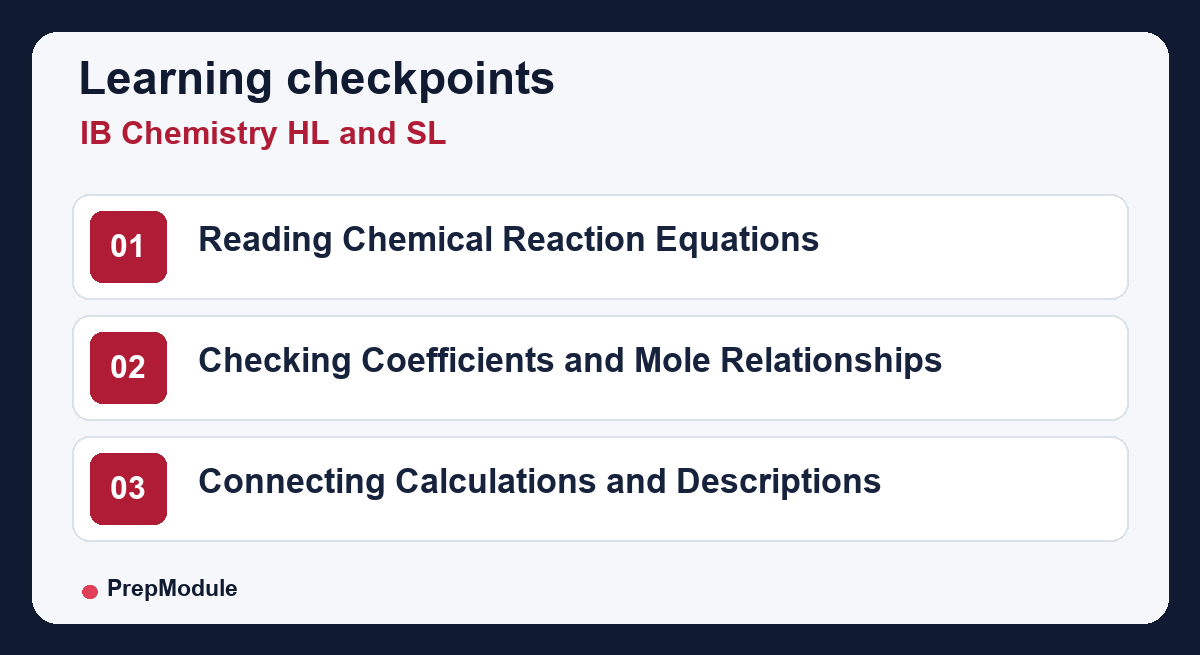
Check if you can read the coefficients in reaction equations.
For example, in the hypothetical reaction 2A + B → 2C, assuming there are 4 moles of A and sufficient B, 4 moles of C will be produced. Conversely, if B is insufficient, you would not be able to arrive at the same answer.
The key to this example is not complex calculations. It lies in seeing if you can explain for yourself which substance to use as the basis for the ratio and what limits it.
Do not study calculation problems and descriptive questions separately.
I recommend practicing explaining the chemical change the answer implies in a single sentence, rather than stopping at simply checking the numbers and units after solving a problem.
As you accumulate practice in verbally explaining concepts that are difficult to observe, such as particle movement, bonding, and energy, it becomes easier to connect what you have learned when encountering new problems.
Chemical calculations are correct only when unit conversions are correct
Assume, through a hypothetical calculation on paper, that 0.25 mol of solute is present in a solution with a volume of 500 cm³. Since 500 cm³ = 0.5 dm³, the amount of substance concentration is 0.25 ÷ 0.5 = 0.50 mol/dm³. If you divide directly without converting the volume, the value can differ by a factor of 1,000. In the answer key, write down the relationship used, the converted value, the answer, and the units in order so that you can check it yourself.
Describe the concept after the calculation
When studying the effects of chemical bonding and structure on the properties of matter, do not stop at simply writing the names of the bonds. It is necessary to practice explaining melting points or differences in states based on the structure of matter or interactions between particles. Divide each unit into three categories—concept explanation, numerical calculation, and data interpretation—according to the school syllabus, and then repeat the areas where you are lacking. Content related to actual experiments must be studied strictly within the school's guidance and safety standards.
To supplement both calculations and concepts in Chemistry
Checking basic calculations and units
Use recent exams to identify which steps in the relationship between amount of substance, molar mass, concentration, and reaction equation coefficients are confusing. It is recommended to practice starting with small problems until you can explain each symbol and unit in the equation.
Solving problems by connecting units
After understanding the relationship between atomic structure, bonding, energy, and chemical calculations learned in school, solve various problems. You can discuss teaching methods that explain how to apply the same equation when conditions change.
Preparation for In-School Academics and Assessments
We will check class schedules and availability by allowing you to select only the specific areas you want, such as supplementary lessons for specific units tailored to HL·SL, data interpretation and descriptive problems, and understanding concepts from self-completed assessment assignments.
Connecting Calculations and Descriptions
Official resources
Do you need IB Chemistry classes?
PrepModule offers international-school tutoring, SAT and TOEFL preparation, competition preparation, and U.S. college admissions counseling tailored to each student. Our tutors include an MIT computer science major and a research and writing tutor pursuing a PhD in Political Science at LSE. We check tutor availability and scheduling for your requested subject.
Instead of packages that include unnecessary classes, you can select subjects and class durations based on the student's situation.
Please let us know which parts of chemistry calculations, concepts, or descriptive problems you are struggling with, as well as your specific HL·SL level. We will provide consultation on classes focused on the Chemistry units you need.
