AP Chemistry FRQs: connecting calculations and chemical concepts
Connect quantitative chemistry with written explanations and check the reasoning behind answers.
If you are a student preparing for AP Chemistry FRQs (Free Response Questions), you may have received feedback that the explanation in your answer was insufficient, even though your calculation result was correct.
This is because it is important to show the basis on which you obtained that result.
Showing Not Just the Answer, But the Calculation Process and Reasoning
In an answer, the process is just as important as the result.
In chemistry problems, before calculating concentration or moles, you must examine what the given quantity is and how it relates to other quantities. Just as with reaction coefficients or the volume of a solution, if conditions change, the calculation result may also change.
After calculating the numbers, check the units and their meanings.
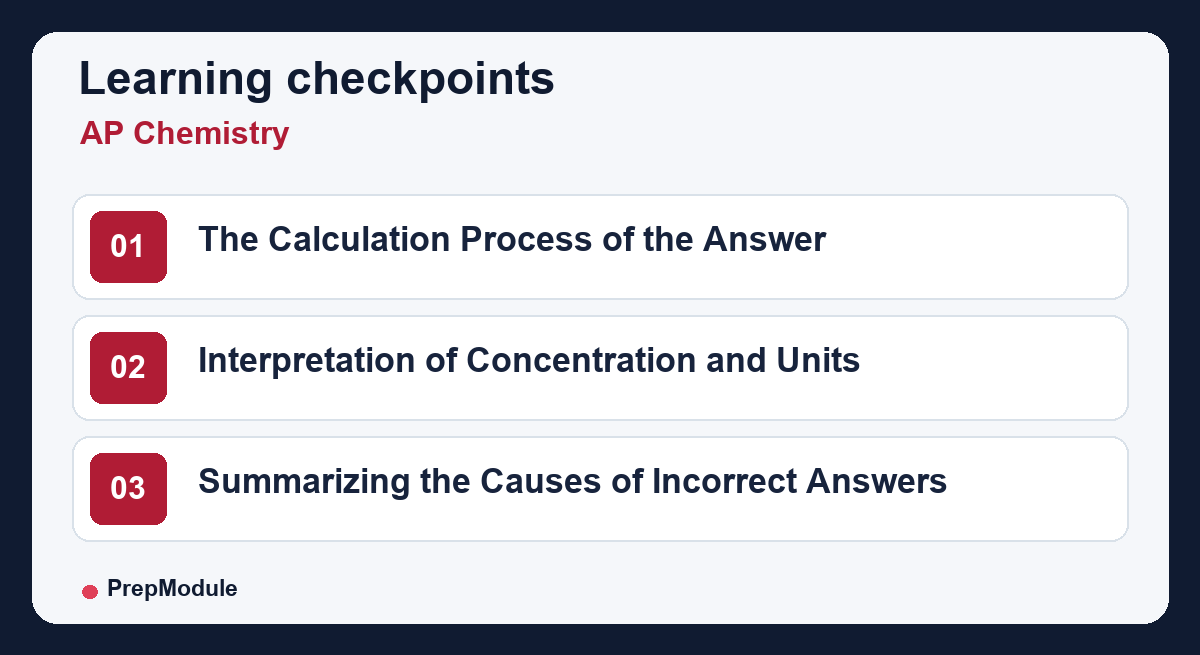
Let's take a problem involving calculating concentration as an example.
If a hypothetical solution contains 0.20 moles of solute and has a volume of 0.50 L, the concentration is 0.40 mol/L. Here, you must also be able to explain that if the volume increases while the amount of solute remains the same, the concentration decreases.
Practicing explaining these simple relationships verbally helps you determine what needs to be calculated in complex problems.
The way you organize the problems you have studied is also important.
Utilize the College Board's subject-specific official materials and try to distinguish whether the incorrect answers were due to calculation errors or insufficient explanation of concepts.
The process of verifying whether the same concepts can be applied to new problems is more important than simply memorizing the correct answers.
Important Relationships in Stoichiometry Calculations
Let's assume a hypothetical scenario on paper where the reaction equation 2A+B→2C is given, and there are 4 mol of A and 1 mol of B. According to the ratios in the equation, 2 mol of A can react with 1 mol of B, so B is the limiting reactant, and theoretically, C is 2 mol. Having more A does not mean that all of C will be produced. Develop the habit of calculating the answer after comparing the amounts of each substance by dividing them by their coefficients.
How to Use FRQ Scoring Criteria
After solving a problem, identify any missing parts among the calculated values, units, reaction equations, and concept explanations. For example, if you are asked the reason for a specific change after calculating the concentration, you should write down which concept explains the result instead of simply rewriting the numerical value itself. You can use the College Board's public questions and scoring guidelines to identify parts of the process you missed, even if your answer was correct. Actual experiments must be conducted under the safe supervision of a teacher.
Try preparing for AP Chemistry by separating calculations, concepts, and FRQs
Finding the cause of calculation errors
Identify which stage—unit conversion, reaction ratios, or equation organization—you get stuck at in recent homework or exams. Differentiate between information that needs to be memorized and information that can be derived logically.
Explanatory solutions
Read a hypothetical textbook material, determine whether a particle-level explanation is needed or if concepts regarding energy or equilibrium are required, and then write down the calculations and reasoning together. You can practice explaining the reasoning behind your answers by reviewing formula FRQs and scoring guidelines.
Only the scope needed by the student
You do not need to start the entire AP Chemistry course from scratch. Please inquire about classes tailored to your school's situation, such as equilibrium concepts, units and calculations, data interpretation, or FRQ feedback right before the exam.
Summarizing the Causes of Incorrect Answers
Official resources
Do you need AP Chemistry classes?
PrepModule offers international-school tutoring, SAT and TOEFL preparation, competition preparation, and U.S. college admissions counseling tailored to each student. Our tutors include an MIT computer science major and a research and writing tutor pursuing a PhD in Political Science at LSE. We check tutor availability and scheduling for your requested subject.
Instead of packages that include unnecessary classes, you can select subjects and class durations based on the student's situation.
Please send us the chapters you are currently studying, such as stoichiometry and equilibrium, along with difficult problems from FRQs. We will consult with you to determine the necessary Chemistry classes tailored to your level.
