How to prepare for U.S. college admissions from Grades 7–10
Plan foundations, course choices and genuine interests with a free editable Grades 7–10 admissions checklist.
Free planning resource
Grades 7–10 admissions checklist
Use this as a semester planning sheet, not a list of mandatory admissions activities. Start with the student’s current needs and choose realistic next steps.
| Grade | Next step | What to keep |
|---|---|---|
| 7–8 | Review school mathematics and English foundations | Class feedback; one skill to practice |
| 7–8 | Explore one subject or interest through a small project | A short reflection or project record |
| 7–8 | Build an independent weekly study habit | A realistic schedule |
| 9 | Ask the school about course pathways and prerequisites | School course catalogue or counselor notes |
| 9 | Choose activities that match genuine interests | Role, effort and what was learned |
| 9–10 | Review strengths and gaps before choosing advanced courses | Recent assignments and academic feedback |
| 10 | Check potential majors and university prerequisites | Links to official university pages |
| 10 | Explore suitable research, competition or service opportunities | Eligibility and school support |
| 10 | Discuss an eventual test plan if relevant | University policy and school calendar |
| 7–10 | Review the plan each semester and adjust priorities | One next action and a review date |
Open in Excel, Google Sheets or another spreadsheet app. The file is free and requires no sign-up.
If you are interested in U.S. college admissions, you are likely wondering at what grade level you should start preparing.
If your child is still in grades 7 through 10, this is an important time to solidify their academic foundation and discover their interests, rather than setting specific college names or specific qualifications.
Gradually Building School Studies and Areas of Interest
First, take a look at what they are studying at school.
It is recommended to understand the school's basic subjects, such as math, English, and science, and to develop a habit of self-study. Checking which educational programs they can transition to in the future, such as IB, AP, or IGCSE, will also be helpful when selecting subjects.
Not all students need to prepare for the same exams or competitions at the same time.
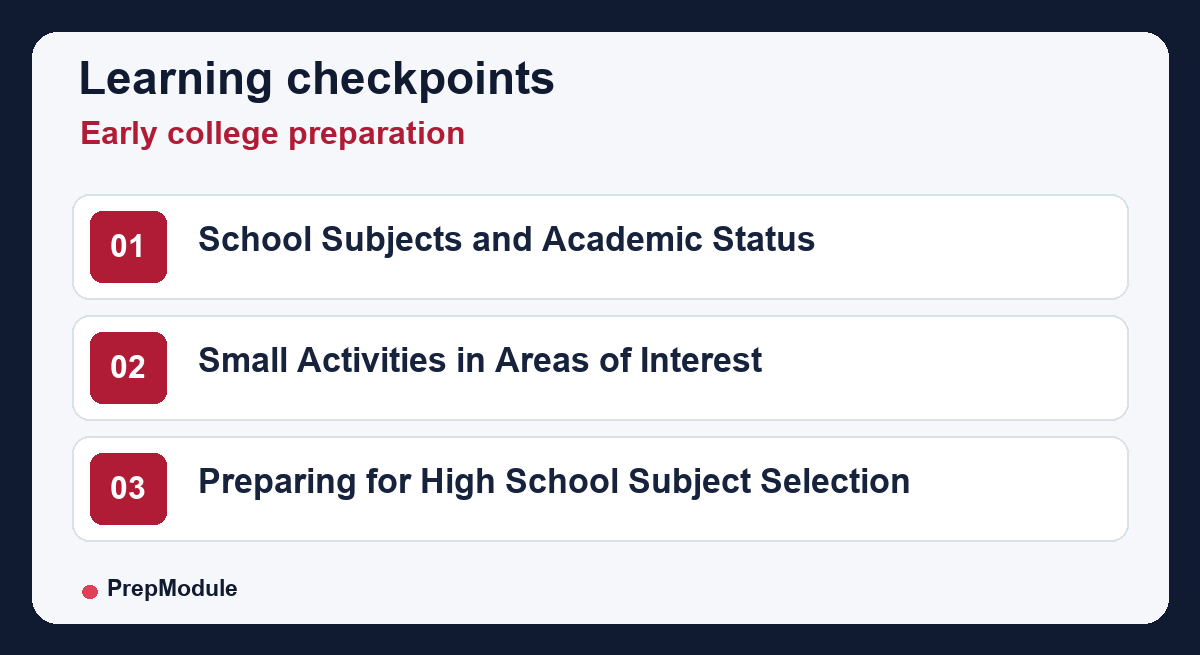
Areas of interest can start with small activities.
For example, a student who likes science can read related books and participate in school clubs to find answers to their questions. A student who enjoys mathematics could try problem-solving activities or competitions at an appropriate level.
It is more important to record what the child actually found interesting and learned than to list the names or number of activities.
Points to organize before entering high school
It is a good idea to review the elective courses and activities of interest offered by the school to identify the academic foundations the student needs. It is okay if a target university has not been decided yet.
At the appropriate time, you can review the direction of subjects or activities through counseling and select classes that suit them.
What should you keep for each grade level from 7 to 10?
In grades 7 and 8, read and experience various fields to discover subjects and hobbies you enjoy. In grade 9, review high school graduation requirements and subject foundations, and briefly record the activities you participated in. In grade 10, you can further refine your advanced course choices for the following year and projects of interest. Even if you do not yet know your major, simply reviewing the questions you have been interested in so far serves as a sufficient starting point.
Record sheets you can create with your student at home
Organize school subjects and grades by semester, interesting questions from class content, clubs, competitions, and projects participated in, as well as your role and reflections, into a single document. This is a tool to verify the changes in the process that the student has actually experienced, rather than forcing activities to fill out an application. Since college application requirements vary by school and year, update this later by checking official admission information.
If you are a student in grades 7–10, what should you prepare first with the PrepModule?
Check your current standing by grade
You can organize your current school's curriculum, grades, favorite subjects, and activities to discuss them in a one-time consultation with experts, such as former U.S. college admissions officers. If you haven't decided on a desired major yet, consider starting by exploring subjects and interests.
Balancing Academics and Activities
For example, if an 8th-grade student is interested in coding but struggles with algebra, they can attempt small coding projects while stabilizing their math studies. Plan subject selection for the next grade level and experiences in your areas of interest together.
Start with necessary classes
After the consultation, you can select as many subject supplements, competitions, or classes in your areas of interest as needed. You do not need to finalize your admission results for your current grade level, nor do you need to pay for all programs simultaneously.
Preparing for High School Subject Selection
Official resources
Grades 7–10: If you are still feeling lost about college admission preparation
At PrepModule, you can consult U.S. university admissions experts, including former Harvard College admissions officers. You can also discuss coursework and extracurricular preparation with subject tutors, including an MIT computer science major and a research and writing tutor pursuing a PhD in Political Science at LSE.
You can request admissions counseling on a per-session basis, and afterward, you can choose as many necessary classes and activity preparations as you like.
Please let us know your current grade level, school curriculum, and areas of interest. We will work together to help you determine the necessary coursework and activities at your own pace.
