IB Psychology: building evaluative answers from research cases
Learn how to connect psychological concepts to study evidence and avoid overclaiming findings.
In IB Psychology, you will encounter various theories and research cases. Even if you remember the researchers' names and results, you may not be able to connect them to what the question actually asks.
Before memorizing a study in its entirety, it is important to examine what questions the material answers.
Examining research design and limitations of evidence together
By what criteria should you organize the study?
If the study explains a specific behavior, try to connect what was investigated, how the data was obtained, and how the results can be interpreted.
You must also check the IB Psychology guidelines applicable according to the assessment year.
You can utilize this knowledge for new questions when studying by connecting it to concepts, rather than just memorizing the names of the studies.
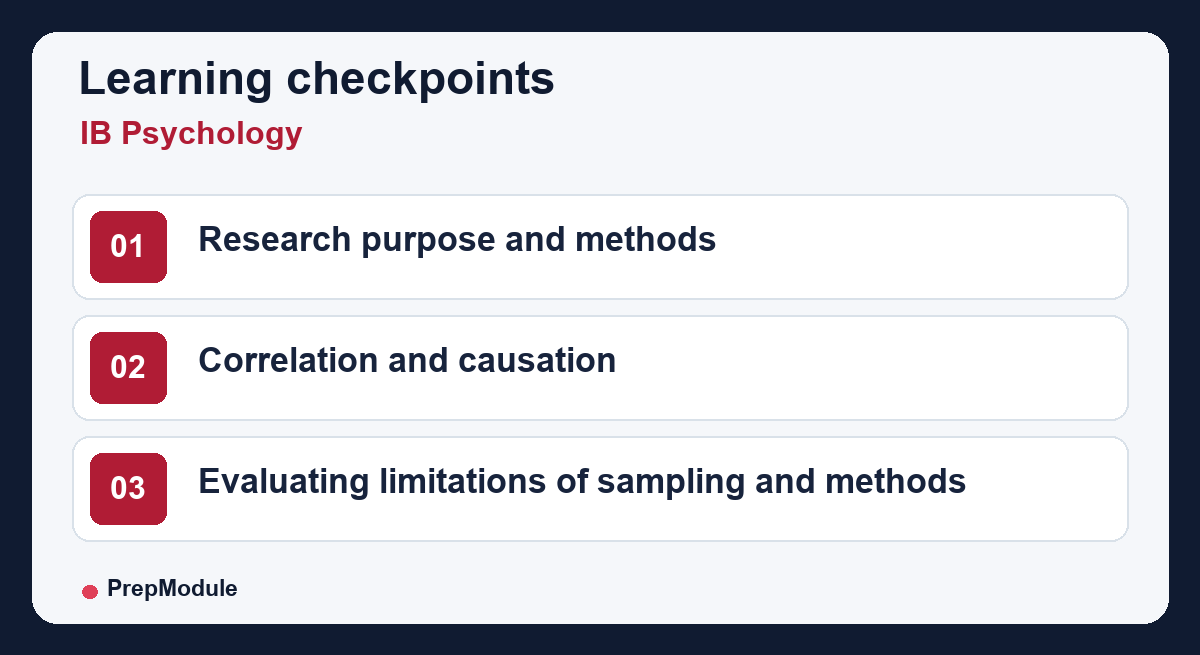
Just because two variables move together does not mean one is the cause.
For example, let's consider a hypothetical observation that students with longer sleep times scored higher on a memory test. You cannot conclude that sleep is necessarily the direct cause of the result simply because there is a relationship between the two variables.
You must also examine other variables or measurement conditions.
This is the reason for distinguishing between correlation and causation when explaining.
When evaluating, rather than simply stating that the sample size is small,
think specifically about which group the study could be applied to, what was measured, and what results might be obtained if approached in a different way.
Practicing explaining the evidence and limitations while comparing similar studies will make your evaluative answers much richer.
Elements to compare when organizing research cases
Let's assume that the average scores of two groups differed in the results of a hypothetical memory experiment. Even if you pay attention to that difference, you must verify what the research design was and whether there is a possibility that other variables intervened in the group assignment process. How representative the participants' results are of the entire group and whether the measurement tool accurately reflects the target concept are different questions.
How to Write Specific Explanations in Evaluative Answers
When explaining a study, try to organize the research question, methods, key results, and interpretation separately. Then, instead of using a general statement like "the sample was small," it is better to connect the difficulty of generalizing the results to specific groups or situations due to the characteristics of the sample. You can also compare whether similar results were obtained in different studies or consider alternative explanations. Learn the criteria for evaluation rather than memorizing the entire research case.
How to Evaluate Cases in Psychology Exams
Structuring Concepts
Compare the psychology theories studied in school with research cases to verify whether the student can explain the research question, key results, and the relevance of concepts.
Finding the Basis for Assessment
Read hypothetical research data related to learning and discuss how sample representativeness or measurement methods impose limitations on the conclusions. Rather than simply listing research, it is necessary to practice selecting cases that fit the perspective of the question and evaluating the evidence.
Customized Lessons by School Progress
You can inquire about the availability of classes by selecting necessary subjects, focusing on the curriculum corresponding to the student's exam year, feedback on descriptive answers, and supplementary lessons for weak units.
Evaluating limitations of sampling and methods
Official resources
Inquiry on IB Psychology Descriptive Answer Classes
PrepModule supports the learning needs of each student, ranging from international school curriculum to U.S. university admissions. We have teachers specializing in various fields, including a tutor in politics, research, and academic writing who is a PhD candidate in Political Science at LSE and an Oxford researcher.
You are not bound by long-term packages; you can select the subjects and writing areas you need individually and apply for as many times as you desire.
If you inform us of the psychology units currently being studied, research cases, and difficulties with descriptive answers, we will provide consultation on Psychology classes tailored to the student's actual school assessments.
