Preparing for Computer Science and AI at U.S. universities: coding, USACO and projects
Explore Computer Science and AI majors, high-school mathematics and coding courses, USACO, project ideas and personalized admissions planning.
When looking at students aspiring to major in Computer Science, some already have some proficiency in Python or Java, while others are interested in games or AI but have not yet started coding. Rather than thinking you need to build a decent app just to get admitted, first examine what Computer Science actually entails.
Computer Science is a discipline that studies the principles of accurately modeling problems and solving them efficiently, along with the skills to create programs.
Differences Between CS, AI, and Computer Engineering
Computer Science (CS) studies various applied fields built upon a foundation of algorithms, data structures, operating systems, and programming languages. AI focuses on methods to predict from data or assist in decision-making, making mathematics, such as probability and linear algebra, crucial. Computer Engineering often involves studying areas that bridge the gap between hardware and software. Even in MIT's undergraduate catalog, Computer Science and Engineering, Artificial Intelligence and Decision Making, and Electrical Engineering with Computing are listed as distinct courses.
What subjects should international school students choose?
It is advisable to prepare for mathematics consistently. Courses such as IB Math AA HL, AP Calculus, A-Level Mathematics, or Further Mathematics can be considered depending on the student's math proficiency and the requirements of their target schools. If IB Computer Science or AP Computer Science A is offered, students can also gain experience in writing structured programs. Physics and writing courses are also helpful for understanding problems and explaining the solution process. There is no need to give up on a major just because your school does not offer CS courses. First, check the high school course guidelines of the universities you are applying to and your own curriculum.
What are good examples for high school projects?
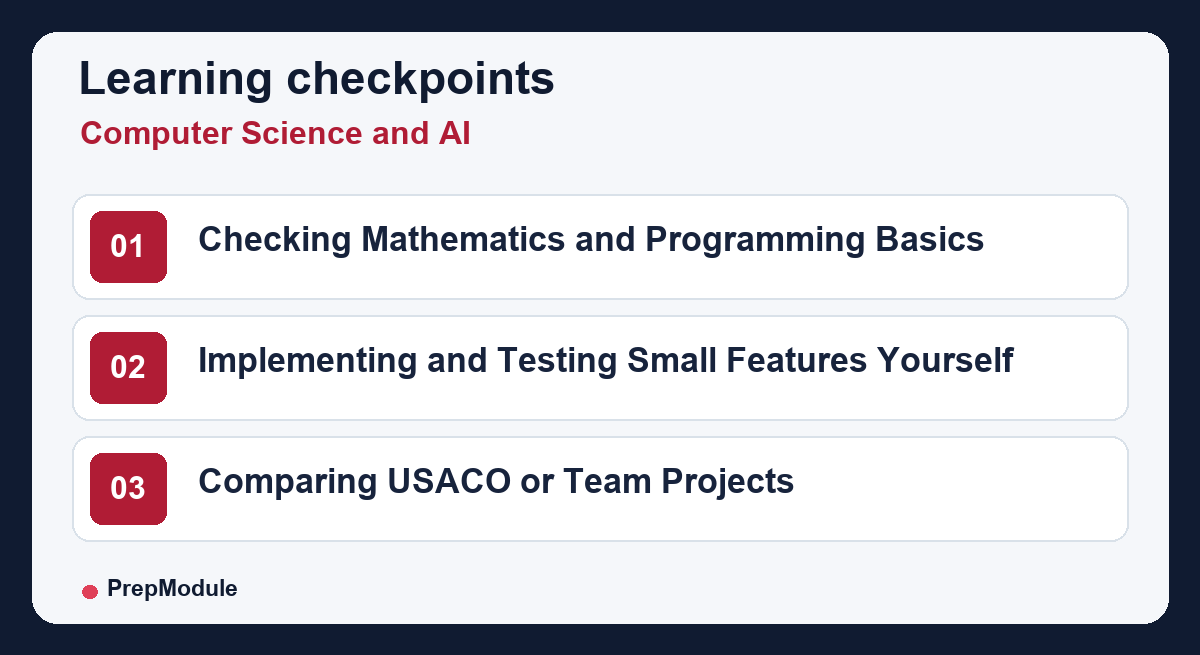
For example, if you are interested in school libraries, you can try creating a small program to assist with book search and classification. You don't need to build a fancy AI service from the start. Implement a search function using a list of publicly available examples, and then try improving it by addressing issues such as how to handle cases where the same word appears twice or how to provide guidance for input errors. You can faithfully explain the project by not collecting actual users' personal information and by documenting test cases, changed code, and the reasons for improvements.
If you are more interested in data science, you can compare hourly demand using traffic volume or rental bicycle aggregation data released by local governments. Rather than just boasting about your predictions, it is important to examine the meaning of the error, such as whether you compared it to a simple baseline model or if it performs similarly even in unobserved seasons.
How is USACO different from robot competitions?
USACO is a great way to gain experience in algorithmic programming, solving given problems within limited conditions. While divisions such as Bronze, Silver, Gold, and Platinum are known, official score certification and invitation methods are subject to change by season. International students solving online problems are separate from eligibility for selection to the U.S. national team. As FIRST Robotics activities involve working in teams to handle mechanics, electronics, and software together, it offers a unique experience for students interested in collaboration and actual design.
| Activities | Results to be verified |
|---|---|
| Algorithm problems | Efficient solutions, time complexity, error analysis |
| Custom programs | Working functions, bug logs, tests and user requirements |
| Data projects | Data sources, evaluation criteria, errors and limits |
| Robot team | My role, design changes, team collaboration |
Approaching by grade level
For grades 7 through 9, try focusing on one basic programming language, fundamental mathematics, and small, complete programs. In grade 10, it is recommended to learn data structures and problem-solving or take on a role in a club project. In grade 11, it is best to define your own questions and continue a project within a specific field of interest. Delegating tasks to others and merely bringing back the end product is not helpful for verifying your skills or writing your application.
What subjects will you encounter if you study CS in college?
In college computer science majors, you do not just learn programming languages; you study foundations such as data structures, algorithms, discrete mathematics, and computer systems. Students interested in AI or data science can also explore how mathematics, such as probability, statistics, and linear algebra, is applied. If you look up the prerequisites for introductory programming and algorithms in the university's official course catalog, you will get a sense of what foundations you need to build in high school.
For example, in a search problem, you can compare the difference between reading every item sequentially and narrowing down the range by checking the median in a sorted list. It is not just about looking at whether the program produces the correct results, but also considering which approach is easier when the input becomes large. This kind of problem-solving experience connects to algorithm learning in college.
Criteria for Properly Completing a Small Project
Let's say you want to create a program that can search for virtual school timetable data. First, limit the necessary functions to two or three and organize the example data yourself. Afterward, you can test situations such as searches with no results or the same title appearing multiple times. Leave a short README explaining what problems you encountered and how you fixed them, along with example inputs and outputs. You can practice sufficiently without collecting other people's actual personal information.
Students interested in AI can consider what criteria to apply to compare results in prediction problems using publicly available, non-sensitive data. Rather than selecting and showing only cases where the predictions matched well, it is better to compare them against simple criteria and explain the situations in which errors occurred. You do not need massive models or paid equipment right from the start.
How should I connect competitions with club selection?
If you enjoy algorithm problems, you can find problems suitable for your level in USACO's official practice materials or your school's programming club. If you are interested in creating usable tools, you can consider requirements, testing, and user experience in small team projects. FIRST's educational robotics team activities may be suitable for students interested in hardware and software collaboration.
Set specific goals for the semester, such as understanding new data structures or completing a small program without stopping, rather than simply stating the number of problems solved. It becomes easier to explain your activities if you distinguish between the parts you wrote yourself, the parts you collaborated on, and the parts you changed based on feedback. If your school does not offer CS classes, you can start by finding possible learning paths while diligently studying mathematics and other regular subjects.
How to Utilize PrepModule's Classes and Counseling When Preparing for a CS/AI Major
Identifying Strengths and Academic Foundation
Organize your current school math and computer science curriculum, programming experience, and CS topics of interest. For students considering CS or AI, this allows you to explore which direction—software development, mathematical modeling, or data analysis—is right for you.
Level-based Project Learning
Beginners can start by creating programs to process simple academic data using strings, lists, and loops, while students with a foundation can attempt analysis using public data or compare efficient algorithms. Inquire about related classes with tutors such as MIT Computer Science major tutors.
Checking College Preparation Direction
You can discuss in admissions counseling how to connect USACO, school math and computer science classes, and student-independent projects with your major interests. I only request classes per session for necessary coursework and competition preparation.
The number of GitHub repositories is less important than the code you have written and your ability to explain why you improved it.
Official resources
Inquiry regarding preparation for Computer Science/AI majors
PrepModule is an educational service that supports both international school curriculum classes and university admissions. We have tutors in Math, Physics, and Coding who majored in Computer Science at MIT, and we identify teachers suitable for the student's school curriculum and requested subjects.
You can apply for only the subjects and units you need, as many times as you want, without having to pay for a fixed package.
Please let me know about your coding experience, math proficiency, and any projects you would like to create. We can discuss math and coding classes and project preparation tailored to your interests.
