Mathematics vs Statistics vs Data Science: majors, competitions and projects
Explore differences between Mathematics, Statistics and Data Science majors, recommended high-school subjects, math competitions and data projects.
Engineering is not necessarily recommended for students who are good at math. Students who find proofs themselves interesting, those who enjoy interpreting results through probability, and those who want to solve real-world problems using data can compare different majors.
Mathematics, Statistics, Data Science
Mathematics is a major that studies the principles of mathematics itself, such as abstract structures, logic and proofs, and analysis. Applied Mathematics places emphasis on applying these mathematical tools to real-world problems. Statistics analyzes uncertain data and examines what can be inferred from that data. Data Science is a discipline that combines statistics, coding, and field knowledge to refine and analyze data. The actual required courses can vary significantly from school to school compared to the major name.
If you are considering applying for a Mathematics major, check not only your ability to get many questions right but also whether you can explain the reasoning and assumptions behind your solutions.
Subject Selection and Fundamentals
Studying courses such as IB Math AA HL, A-Level Mathematics, Further Mathematics, or AP Calculus can be beneficial for your growth. If you enjoy statistics, look into AP Statistics or probability and statistics courses available at your school to see if you have an interest in data interpretation. Since the offerings vary for each target university and school, I cannot unconditionally recommend a single subject.
AMC and Math Modeling Assess Different Abilities
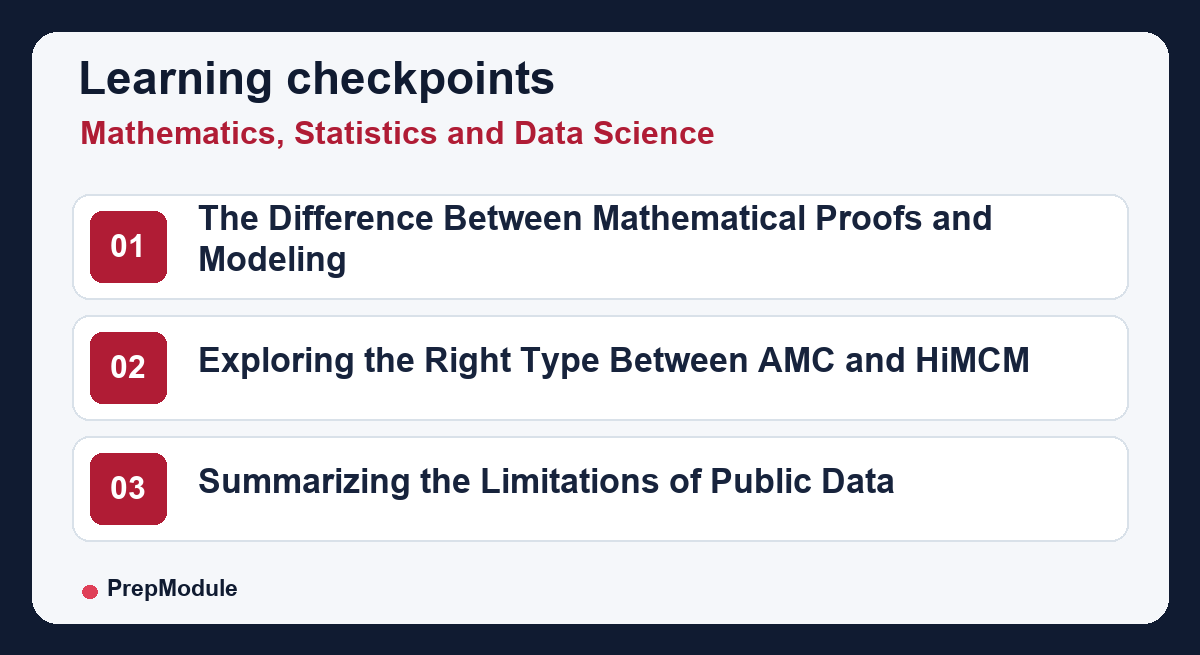
The AMC is an individual exam where students solve math problems within a limited time, and students who achieve a certain score are considered for an AIME invitation. There are separate rules for advancing to international competitions or selecting U.S. representatives. On the other hand, HiMCM is a method in which teams mathematically represent real-world problems and submit reports containing assumptions and conclusions. Even students accustomed to problem-solving can experience that there is no single correct answer in a modeling report.
| Areas of Interest | Small Activities |
|---|---|
| Proofs | Comparing Different Solutions in a School Math Club |
| Probability & Statistics | Comparing Means and Distributions in Publicly Aggregated Data |
| Modeling | Comparing Improvement Methods for a Hypothetical School Bus Timetable |
| Data Science | Explaining Simple Prediction Criteria and Errors Using Public Data |
If You Want to Do Research
Try defining small questions using non-sensitive data, such as public traffic data or school timetables. For example, you could think about how you can demonstrate how different two schedules with the same average waiting time actually are. Do not stop at presenting the analysis results; instead, summarize on one page what assumptions were made, what the units and time periods of the data are, and in which cases it is difficult to apply.
Preparing One Step at a Time
I recommend focusing on various math problems and basics during grades 7–9, writing explanations of solutions or modeling activities in grade 10, and problems tailored to your areas of interest or relatively long projects in grade 11. It is more realistic to choose one by one, considering your interests and school schedule, rather than needing to participate in every competition.
Differences in Questions Handled by Mathematics and Statistics
Proving that the properties of a hypothetical simple arithmetic sequence always hold is a good example for practicing mathematical thinking. On the other hand, reading real data to determine what can be estimated from various observations and assessing the degree of uncertainty in those estimations is connected to statistics. Data science often utilizes both statistical thinking and programming to organize data and interpret analysis results. Depending on the university, this field may be offered as a separate department or integrated into the curriculum of various majors.
By comparing foundational courses such as Calculus, Linear Algebra, Probability, Statistics, and Programming with advanced electives in the official major list, you can identify which field you find more interesting.
Math and Statistics Activities at the High School Level
For example, compare the average usage and dispersion by day of the week in publicly available bicycle rental data. Check the units of the graph and the data collection period, and consider what explanatory variables, such as holidays or weather, might be involved. Do not stop at simply calculating the statistics; explain which assumptions cause the differences and whether there might be variables not included in the data.
These problems require a different type of thinking than that required for math competitions. Solving AMC problems can serve as practice for logical problem-solving and the application of concepts, whereas public data projects place greater emphasis on the ability to define the scope of realistic questions and understand the limitations of analysis. Depending on your area of interest, you can experience both types of activities to identify the approach you prefer.
How to Organize Results
Record the source of the problem or data, the learning process, your chosen analytical method, a sentence explaining the results in your own words, and questions you would like to investigate next. Why a student chose a method matters more than whether the solution or graph looks polished. Students can then strengthen gaps in their foundations through school subjects such as IB Mathematics, AP Statistics, Calculus, and A-Level courses.
Student-Specific Study Plans for Mathematics, Statistics, and Data Science Majors
Identifying Math Interest and Foundation
Determine which activities the student enjoys more: proving the reasoning behind a problem, interpreting real data, or solving problems using programs. Also, review the required courses for university majors and the school mathematics curriculum.
Activity Experience by Field
Students interested in Math can compare various solutions to math competition problems, Statistics students can explain the distribution and representativeness of public data, and Data Science students can work on projects to organize and present data using simple code.
Selecting Courses to Build Skills
You can discuss necessary courses tailored to your progress, such as school IB, AP, and A-Level math, math competition math, basic coding, and public data analysis. Consultation regarding majors and activity directions can be requested separately.
Compare undergraduate courses in Mathematics, Statistics, and Data Science, then select the math activity you enjoy the most.
Official resources
- MIT Registrar · 2026–2027 Undergraduate Major List
- MIT Admissions · Academic Foundations
- MAA · American Mathematics Competitions
- MAA · Invitational Competitions (AIME, etc.)
- Introduction to COMAP · HiMCM / MidMCM · Participation Requirements
- SIAM · M3 Challenge 2027 Official Rules
- USACO · Official Season Announcement
Inquiry on Preparing for Math, Statistics, and Data Science Majors
PrepModule is an educational service that supports both international school curriculum classes and university admissions. We have tutors in Math, Physics, and Coding who majored in Computer Science at MIT, and we identify teachers suitable for the student's school curriculum and requested subjects.
You can apply for only the subjects and units you need, as many times as you want, without having to pay for a fixed package.
Please let us know your current math curriculum and experience with statistics and coding. We will consult with you on courses needed for advanced math study and data projects, tailored to your interests.
