Academic competitions & Olympiads
Eight STEM competitions for high-school students: AMC, USACO, ISEF, FIRST and Olympiads
Compare AMC, USACO, FIRST, HiMCM, ISEF and science Olympiads, with a free editable competition planner.
Free planning resource
STEM competition planning tracker
Compare official entry routes and record the dates that apply to your own school, country and competition year. The download includes blank fields for registration, deadline, team and preparation status; it does not invent dates.
| Competition / official site | Check before planning |
|---|---|
| AMC / AIME | School or eligible host; AIME qualification |
| USACO | Contest rules and division |
| FIRST | Age range, team and regional program |
| HiMCM | Team size, advisor and registration window |
| ISEF | Affiliated fair and research approvals |
| Physics Olympiad (US example) | National eligibility and selection rules |
| Chemistry Olympiad (US example) | National eligibility and local qualifying event |
| Biology Olympiad (US example) | School registration and national rules |
Open in Excel, Google Sheets or another spreadsheet app. The file is free and requires no sign-up.
Hello from PrepModule. When students preparing for engineering or natural science majors at U.S. universities look into competitions, names like AMC, USACO, and ISEF frequently appear. Although these are all STEM competitions, their preparation and the work students submit differ significantly. In this guide, we introduce eight representative competitions and their entry pathways. We did not select them based on admissions advantages or the likelihood of winning awards.
Start by choosing the type of activity that fits the student’s academic record and interests. There is no need to prepare for all eight competitions.
Top 8 STEM Competitions at a Glance
| Competitions | What Students Do | What International School Students Should Look For First |
|---|---|---|
| AMC → AIME | Individual Math Problem Solving | Official Overseas Test Centers, Age/Grade, Invitation Requirements |
| USACO | Algorithm Problem Solving & Code Submission | Online Participation Open, Separate Route for US Representatives |
| FIRST FTC/FRC | Team Robot Design/Building and Games | Local Operating Partners and School Teams |
| HiMCM | Math Modeling Reports for Teams of Up to 4 | International Participation, Supervising Teacher and Team Registration |
| Regeneron ISEF | Advanced Research Projects, Exhibitions, and Q&A | Accredited Regions Participation Starting from the Competition |
| F=ma / USAPhO | Physics Problem Solving · Advanced Tests | U.S. Test Locations and Eligibility Requirements |
| USNCO | Chemistry Test · Tiered Selection | U.S. Domestic & Overseas School Enrollment and Citizenship Requirements |
| USABO | Biology Test · Tiered Selection | U.S. School-Centric, Separate Advanced Selection Requirements |
Math & Computer Problem Solving Types: AMC and USACO
The AMC is a competition that tests mathematical problem-solving skills. Middle school students may consider the AMC 8, while high school students may consider the AMC 10 or 12 according to their grade and age. The AIME is an invitation-only exam based on AMC 10/12 scores, etc., and is not the next exam you automatically participate in after taking the AMC 8. USACO provides experience in solving problems under various input conditions through coding. For the 2025–26 season, the certification and invitation methods for some divisions have been revamped, so please do not rely solely on the promotion explanations in the old blog; please check the official season guide.
Engineering & Applied Mathematics: FIRST and HiMCM
FIRST FTC or FRC involves teams building and operating robots suited to given game tasks. Even within the same team, roles vary, including mechanics, coding, and strategy. HiMCM is a competition where participants create mathematical models of real-world problems and write reports, unlike calculation problems found in textbooks. It may be suitable for students who prefer activities involving reviewing various assumptions and dividing tasks among team members.
Research Presentation: ISEF
This is a format where participants exhibit and receive evaluations on research results regarding topics they have already explored. Students do not submit their research directly to Regeneron ISEF online; instead, they must qualify for entry through the ISEF Affiliated Fair. Since each research project has required preliminary procedures and a set permitted research period, please check the regulations for the relevant year from the start rather than beginning with the intention of submitting to a competition later.
The similarly named Regeneron Science Talent Search (STS) is a separate research competition program for high school seniors that requires specific qualifications, such as being a graduating student residing in the United States. Do not confuse ISEF with STS as the same competition.
Physics, Chemistry, and Biology Olympiads
F=ma/USAPhO for Physics, USNCO for Chemistry, and USABO for Biology are programs that students interested in concepts and problem-solving beyond the curriculum should consider. However, due to the nature of selecting U.S. representatives, the conditions for participating in the initial exams and the eligibility to proceed to higher-level exams differ. Students attending international schools in Korea do not receive the same qualifications simply because they have chosen the American curriculum. Please check the official national team selection organizations for each country, including Korea, separately.
Try selecting like this
Consider whether the student is willing to solve math problems every week, enjoys designing real objects with friends, and can formulate their own inquiry questions and ponder them for a long time. It is recommended that students in grades 7–9 expand their experience through basic problems and school activities, while students in grades 10–11 should select a single competition considering their target field and realistic timeframe. Avoid registering for multiple competitions simultaneously, as this can cause school grades or enjoyable activities to suffer.
Each competition requires different deliverables.
When choosing a competition, check the format of the test or submission first, rather than the name "STEM competition." AMC and AIME focus on the experience of solving math problems and producing accurate answers within a set time. USACO evaluates whether a program outputs results that meet requirements for various inputs. Modeling competitions like HiMCM involve teams explaining their assumptions and analysis results in a report, while FIRST conducts team activities based on official games and educational systems. As ISEF involves students presenting their own research and explaining its interpretation and limitations, the preparation period differs significantly.
For example, if a student excels at solving math competition problems, it is a good approach to compare their solutions with other methods and deepen their knowledge of related subjects rather than preparing directly for a research competition. Conversely, if they are interested in working on small projects with friends, they can gain experience through modeling reports or the school's robotics club.
Registration Checklist for International School Students
First, please verify the following information with the official website of the organizing body and the teacher in charge at your school. This includes participation requirements based on the student's age, grade level, nationality, or place of residence; available schools or test centers; whether the competition is for individual or team participation; and whether the competition dates conflict with school exams. For research and science competitions, verify the rules and necessary approvals from the school or institution before starting. Just because there is a place overseas where you can take the AMC, etc., does not mean you can automatically enter every U.S. representative selection program.
Since actual registration conditions vary by competition, please ensure that students do not simply apply examples from other schools found online. If you are unable to participate due to time constraints or eligibility, you can first develop the necessary competencies through practice materials released by the organizing body or school activities.
Practical Examples of Setting Preparation Scope by Semester
If you plan to prepare for one semester focusing on the AMC and in-school math activities, prioritize understanding existing math units, reviewing publicly available practice problems, and recording incorrect answers. In the following semester, you can deepen your understanding based on areas you have found interesting through your past experiences and the school schedule. If you choose modeling or team engineering activities, you must first check not only the competition dates but also whether you can form a team, if there is a supervising teacher, and if there is enough time for reports and presentations.
When recording competition results, distinguish between participation and actual awards or advancements, and also note your role and preparation process. Identifying what problems you learned and became able to solve independently is more beneficial for a high school student's long-term learning than simply counting the number of competitions participated in.
From Selecting STEM Competitions to Related Courses: How Should Students Prepare?
Compare Competition Types First
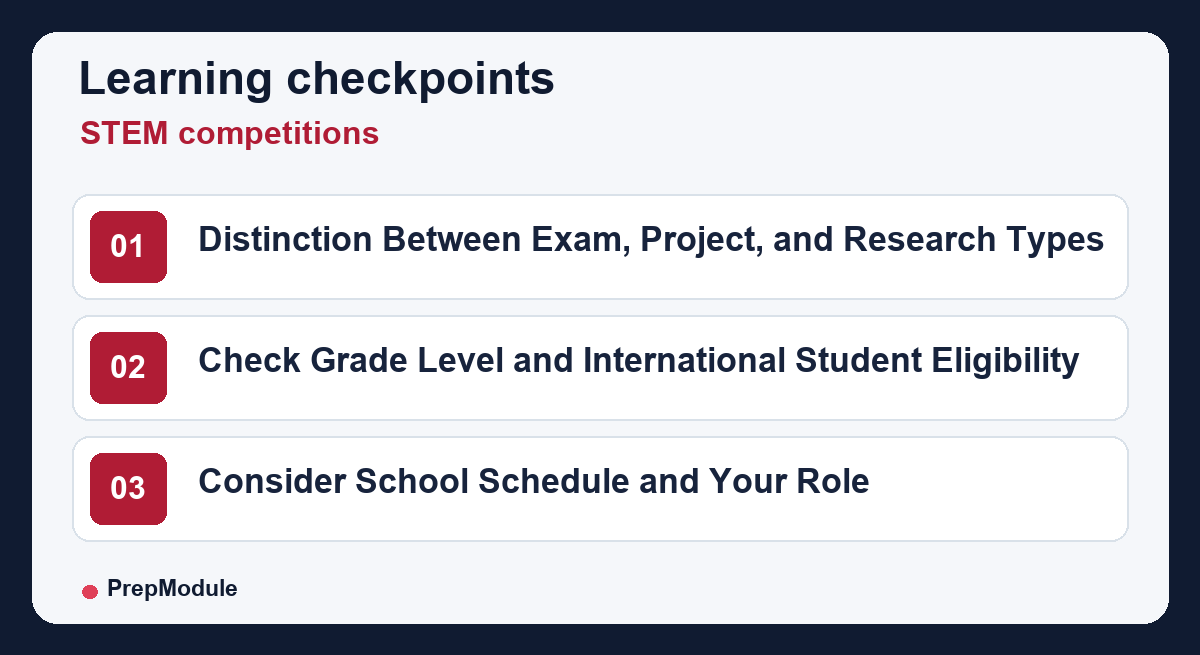
Competitions require different experiences, such as the math-solving type AMC, algorithm-coding type USACO, science inquiry presentation type ISEF, and collaborative production type FIRST. You must check the student's grade level, eligibility, competition schedule, and whether the school is applying.
A Starting Point Fitting Your Experience
If you are still in the introductory stage, it is recommended to study the basics of school math, physics, and coding while solving small problems on your own. If you are already preparing for a specific competition, review past official problems and rules, as well as the necessary school foundations, to determine the required areas.
Separate Admissions Counseling and Competition Subject Guidance
Discuss your major and activity direction with former admissions officers, and afterwards, you can inquire about related classes—such as math competitions, coding, or reading and writing independent research materials—when needed. The focus is on developing the student's capabilities rather than guaranteeing participation or award results.
Winning a competition is not guaranteed. Please distinguish between competitions that allow you to deepen your interest and those you can actually participate in when making your selection.
Official resources
- MAA · American Mathematics Competitions
- MAA · Invitational Competitions (AIME, etc.)
- USACO · Official Season Announcement
- FIRST · Robot Programs by Grade
- Introduction to COMAP · HiMCM / MidMCM · Participation Requirements
- Society for Science · ISEF FAQ
- Society for Science · Regeneron STS FAQ
- AAPT · U.S. Physics Team Rules
- ACS · USNCO Rules & Eligibility
- Official Introduction and Portal for CEE · USA Biolympiad
Inquiry on STEM Competition Preparation
PrepModule is an educational service that supports both international school curriculum classes and university admissions. We have tutors in Math, Physics, and Coding who majored in Computer Science at MIT, and we identify teachers suitable for the student's school curriculum and requested subjects.
You can apply for only the subjects and units you need, as many times as you want, without having to pay for a fixed package.
Please let us know the student's grade level, areas of interest, and experience in math, science, and coding. We can discuss everything from which competitions are suitable for their current level to necessary study sessions.
