IB Geography: organizing case studies for exam answers
Build a case-study notebook that connects places, processes and geographic evidence.
Geography is a subject filled with place names and statistics. Even if you diligently memorize Case Studies, you may struggle to decide which case to use when the questions change slightly.
This is why you should study cases by connecting them to geographical phenomena rather than simply introducing the region.
Connecting the location and evidence of a case to the questions
Try connecting a single case to several questions.
When organizing cases regarding urbanization, instead of just listing locations and population figures, look at the reasons for the changes and the impact they had on the region.
Even with the same case, which parts are relevant will differ depending on whether the question asks about transportation, housing, or resource issues. It is also helpful to note the source and time period of the evidence.
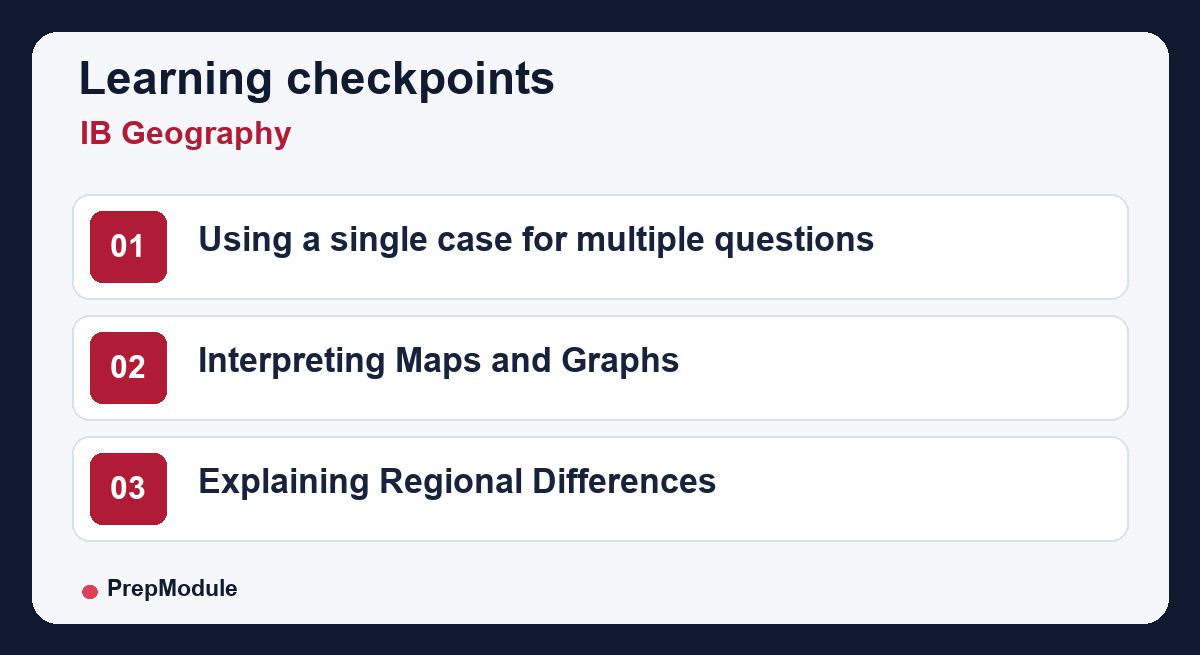
How should maps and graphs be read?
You cannot immediately conclude that a particular region is most affected just because the color on a map is dark. You must check whether the values displayed in the legend represent percentages or total figures, and what the measurement period is.
Your ability to interpret data improves if you first explain spatial patterns and then look for evidence that could be considered the cause.
Good answers reveal regional differences
If the question asks you to evaluate the effectiveness of a policy, consider why it was effective in a specific region and whether the same effect can be expected in other regions.
As you accumulate practice connecting the characteristics and limitations of a case, your Geography answers will not stop at merely reproducing memorized content.
Example of making Case Study notes specific
When organizing urbanization cases, instead of simply writing down the city name, try to distinguish what population changes occurred at what time and how those changes affected housing, transportation, the environment, etc. Even for cases involving the same city, differences in accessibility within the region and impacts by population group may vary. If you record the year and regional scope of the public data serving as the basis, you can use the case for other questions as well.
Order from Map to Argument
For example, if shops are densely concentrated around a train station on a hypothetical map, first describe the distribution. Next, explain that transportation accessibility may be related to the location of the shops, and add that checking data such as rent or population density leads to a more valid interpretation. Separating and listing the distribution, possible causes, and limitations makes the data interpretation type of answer more specific.
Lesson Example for Organizing a Geography Case Study
Check Geographical Concepts First
Review terminology and map/data interpretation according to the school curriculum, covering topics such as population, cities, resources, and mobility.
Practice Using Case Studies
Using the subject of changes in public transportation in a city, connect the spatial scale, causes, and results of the changes with evidence, and compare them with other regions. You can practice selecting and writing information that fits the perspective required by the question, going beyond simply memorizing case names and statistics.
Preparation for Exams and School Assessments
You can request separate classes tailored to your weak areas and exam schedule, such as Case Study note organization, solving data-based questions, and practicing assessment-style answers.
Explaining Regional Differences
Official resources
Inquiry about IB Geography Classes
PrepModule supports the learning needs of each student, ranging from international school curriculum to U.S. university admissions. We have teachers specializing in various fields, including a tutor in politics, research, and academic writing who is a PhD candidate in Political Science at LSE and an Oxford researcher.
You are not bound by long-term packages; you can select the subjects and writing areas you need individually and apply for as many times as you desire.
If you let me know where you are struggling with Case Study organization, map and data interpretation, or essays, I will identify classes and schedules to assist you with your Geography studies.
