Architecture, architectural engineering and design: portfolios and high-school preparation
Compare Architecture, Architectural Engineering and Design degrees, school subjects, portfolios and student-led design activities.
Preparing for architecture programs in the U.S. is not enough simply because you have an interest in buildings. It is important to first find out what type of degree you are applying for, whether a separate portfolio is required, and how the coursework differs from Architectural Engineering or Art and Design. Before you start working on your project, let's examine the differences between the departments.
Architecture, Architectural Engineering, Civil Engineering
Architecture is a field that studies space, design, architectural history and theory, and usability together. In Architectural Engineering or Civil Engineering, there may be courses that focus more on engineering content, such as building structures, materials, and mechanical and electrical systems. Check the actual course lists for each degree to determine whether the architecture program is studio-oriented or focused on engineering subjects.
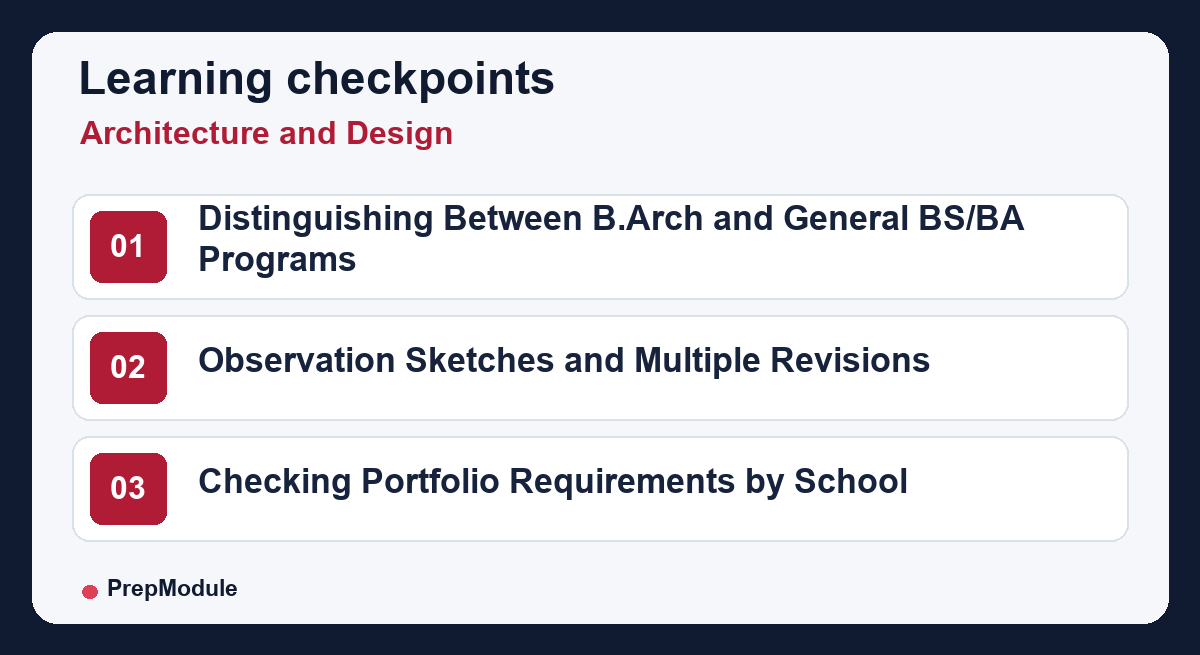
Within Architecture, there are specialized B.Arch programs and BA/BS degree courses, and the academic systems and pathways required to obtain professional qualifications may differ. Cornell’s B.Arch is a five-year professional undergraduate program, and a portfolio and video interview are required for application. These requirements do not apply uniformly to all architecture departments in the United States.
Students considering architecture should document not only completed drawings but also the process of observing problems and designing.
Recommended High School Courses
You can build a foundation for understanding structure and space in Mathematics and Physics, and practice observation and expression in Visual Arts or Design/Art courses. History and Writing also help in understanding the context and cultural significance of buildings. Please check the guidelines for each university to see if specific art courses are required for professional architecture programs.
Portfolio Ideas
You can observe the characteristics of open environments, such as the paths people take when using a space at a nearby library or park, or at what times of day natural light enters. Record the form of the space without identifying or photographing individuals. Compare the ideas from your first sketch with the subsequent revised floor plan, and add a brief explanation as to why you made the changes. You can demonstrate your thought process using various media, such as models, drawings, and photographs.
Reviewing Official Portfolio Requirements
The official Cornell AAP guidelines provide specific application requirements, such as 15–20 slides, a maximum of 2 slides per project, and a video interview. Since these figures are the university's current guidelines, you must verify them to match the year and course you are applying to. Avoid the mistake of applying a portfolio format from one school to the entire university.
If You Plan Activities in Advance
It is recommended that students in grades 8–10 continue to practice sketching and observation. In grades 10 and 11, students select a single theme and revise and document their design multiple times. In grade 12, they select their own work and organize explanations according to the submission format of their respective schools. It is important to note that this is the student's own work, not something created by a third party.
Checking the Differences Between Architecture and Design in University
In the Architecture curriculum, you may encounter classes on spatial design, drafting, design studios, architectural history, and the environment. In Civil Engineering or Architectural Engineering, the emphasis may be placed more on studying the mathematical and physical analysis of structures and understanding technical requirements. Design can consist of completely different subjects depending on the specific areas offered by the school, such as product, visual, or interaction. Compare the official major descriptions and required courses of the schools you are applying to.
Just because you are interested in architecture does not mean that every student must choose the same degree. Even within an architecture major, it is necessary to verify whether the program leads to professional qualifications or is a general undergraduate course, as well as the weight given to studio and theoretical classes. These differences vary not only by university but also by country.
Examples of Work Processes You Can Include in Your Portfolio
Let's assume you are designing a virtual reading space for a school library. First, consider why people use that space and what activities and movement patterns are possible, then create various sketches. Instead of focusing on a single finished drawing, you can create a final product by comparing your initial idea, alternatives, and reasons for modifications. This is an educational project designed to demonstrate a student's design thinking, rather than a design intended for judging actual building safety or for construction.
When selecting media such as photographs, drawings, paper models, or digital images, explain why that particular medium was effective in conveying your ideas about the space. Distinguishing between the parts you created yourself and the parts you received guidance on will also be helpful when organizing your portfolio later.
Read the Portfolio Requirements First
Depending on the university, a portfolio may be mandatory or not. Check the school's official guidelines regarding submission formats, number of works, file limits, and types of works. While diligently studying math and science subjects in high school, you can simultaneously pursue activities of interest such as drawing, design, or reading history. Rather than aiming solely for a stunning finished product, it is better to build a process that reveals the student's observations, expressions, and development based on feedback.
If you are interested in Architecture and Design, separate the competencies you need to prepare from the consultation process.
Compare majors and admission methods.
Check the degree types, portfolio requirements, and school math and art-related subjects for Architecture programs at each university. During admissions counseling, you can review the direction of application and the student's actual interests.
Creating a student's work process.
Observe and sketch living spaces, record circulation, lighting, and user needs, and then compare various ideas. In a portfolio, the process and reasons behind the student's own development are important, rather than a result created by someone else.
Coursework and Writing Preparation
You can inquire about classes as needed for math, geometry, and physics concepts required in the design process, or for explaining your work in writing. Specific areas of design and portfolio guidance will be confirmed during the consultation.
An architecture portfolio is not merely a collection of visually appealing final images, but a record showing how you viewed and developed space.
Official resources
Architecture & Design Major Preparation Consultation
At PrepModule, you can consult U.S. university admissions experts, including former Harvard College admissions officers. You can also discuss coursework and extracurricular preparation with subject tutors, including an MIT computer science major and a research and writing tutor pursuing a PhD in Political Science at LSE.
You can request admissions counseling on a per-session basis, and afterward, you can choose as many necessary classes and activity preparations as you like.
Please let us know your areas of interest, works created to date, and school courses. We will review preparation directions for each major and determine the availability of necessary learning and related mentoring.
