Preparing for Electrical and Computer Engineering: circuits, embedded systems and robotics
Compare Electrical Engineering and Computer Engineering majors, relevant mathematics, physics, coding and high-school engineering activities.
If you enjoy coding but are also interested in physically moving machines or circuits, Electrical Engineering (EE) and Computer Engineering (CE) are worth considering together. In the United States, you can also find the major name Electrical and Computer Engineering (ECE). I will summarize how it differs from CS and what experiences you can gain starting from high school.
Differences Between Electrical Engineering and Computer Engineering
Electrical Engineering is a field that deals with electrical phenomena and systems, including circuits, electromagnetics, signals, communications, power, and control. Computer Engineering places greater emphasis on the intersection of computer hardware and software, such as computer architecture, digital logic, and embedded software. Since names and the boundaries of required courses vary by school, it is easy to distinguish them by reading actual degree charts in addition to the major descriptions.
In ECE, understanding how actual signals and devices operate is just as important as coding.
In high school, accurately understanding the basics of mathematics and physics,
Calculus, functions, and vectors will help in mathematically representing circuits and signals later on. This can also be connected to the electricity and mechanics learned in IB Physics, AP Physics, and A-Level Physics. Taking CS classes or gaining experience handling simple graphs and numerical data with code is also useful. Please consider the subjects offered by the student's school and the manageable workload.
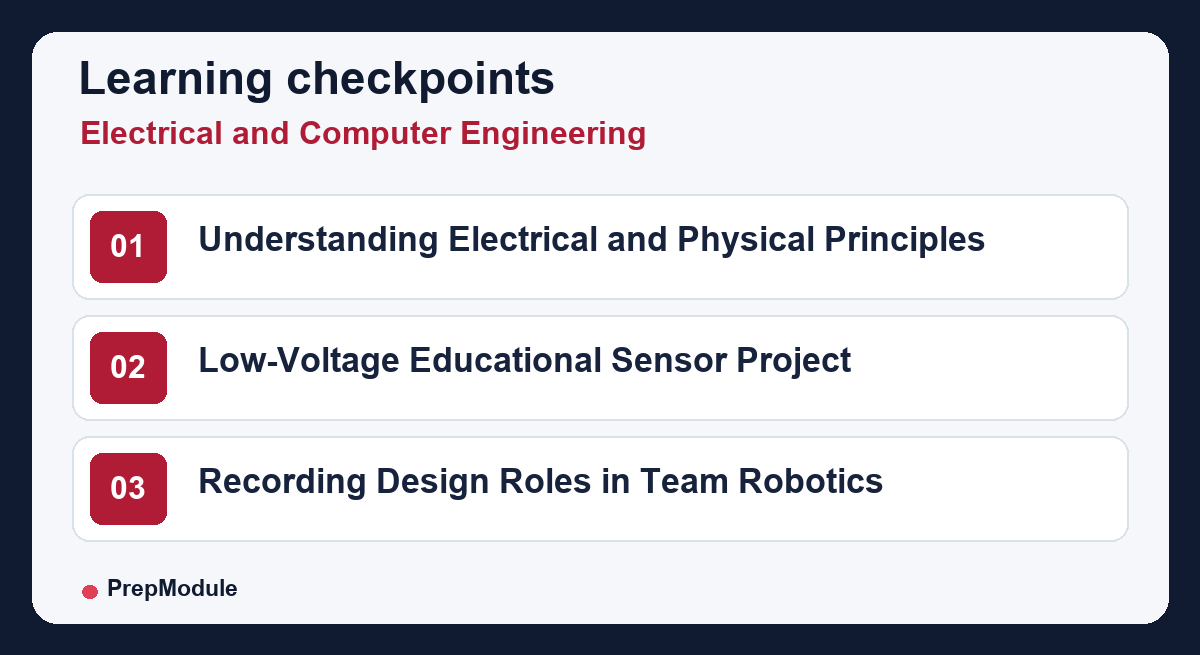
What kind of projects can I work on?
Beginner students can undertake a project to record changes in temperature or light using low-voltage educational science kits under the guidance of a teacher. For example, they can observe how consistent sensor measurements are in the same environment multiple times, graph the results, and reflect on why differences occurred. It is better to understand the principles using safe educational equipment and organize the data rather than building complex circuits from the start. High-voltage equipment or electrical installations requiring qualifications are not handled directly.
Students more interested in design can use commercially available educational robot kits to practice following a set course and record how the coding and structural roles within the team solved problems together. This results in a much more concrete outcome than simply watching a video of the robot moving.
FIRST Tech Challenge and FRC
The FIRST Tech Challenge (FTC) is a team-based program generally for students in grades 7–12, while the FIRST Robotics Competition (FRC) is for students in grades 9–12. Age requirements and participation methods may vary by region, so please check with your school team and local operating partners. Since teams involve various roles such as design, assembly, software, strategy, and documentation, this serves as practice in specifically explaining what you contributed.
How to Keep a Record
Try to summarize about three points regarding what failed in your initial design draft, why you modified it, and the differences before and after the modifications. Rather than simply collecting photos of the competition, distinguishing between the roles you shared with teammates, the parts you understood and implemented, and the issues you have yet to resolve will also be helpful for exploring university majors.
Which courses should I check in a university ECE program?
To compare the specific fields of Electrical and Electronic Engineering and Computer Engineering, examine the required courses on the university's official major pages. A good criterion is how the weight of courses studying Circuits, Electromagnetics, and Signals and Systems differs from that of Digital Logic, Computer Architecture, and Programming. For example, if you consider the process of values obtained from sensors being represented as numbers and processed within a computer, you can understand why electronic devices and code are connected to each other.
In high school, it is necessary to focus on the fundamentals of the curriculum, such as concepts of current, voltage, and resistance, functions and graphs, and the basic relationships between binary numbers. Rather than suddenly attempting to study all college subjects in advance, select relevant school courses by identifying which concepts you find interesting.
How to Present Results in a Project
Under the supervision of a teacher, you can create graphs using example values obtained from safe educational sensor kits or publicly available simulated measurements. For instance, compare values multiple times within a certain range and explain why the average value and individual observations may differ. In the report, record the purpose of the measurement, the units of the data, the results of repeated observations, and the tools and limitations used. Experience explaining the accuracy of observations and modeling can be more helpful than building the complex device itself.
If you participate in a robotics club, understand the operating principles of safe educational equipment and keep a record of your tests. If you are responsible for software work, you can specifically document how the expected input differed from the actual results and what communication took place with the equipment manager.
Example of Learning Paths for Grades 8–11
In grades 8 and 9, thoroughly prepare for basic math and science concepts, as well as the school's basic coding classes. In grade 10, examine the selection criteria for Physics and Mathematics courses offered by the school, and engage in activities utilizing safe measurement data or educational kits. In grade 11, further explore signal/digital systems or software fields of interest, and develop the role assigned to you within a school team. Review major-specific course requirements and school schedules based on official university guidelines and the current curriculum.
Course and Project Preparation Plan for Students Aspiring to Enter ECE
Analysis of Admission Direction
Compare university curricula for Electrical and Electronic Engineering, Computer Engineering, and Computer Science to determine which subject the student prefers: mathematics, physics, or programming. During admissions counseling, you can also review school course combinations and university-specific prerequisite learning requirements.
Connecting from Basics to Projects
Begin with safe learning activities such as low-voltage educational circuit models, circuit simulations, and simple sensor data display programs to understand how physics and coding are connected. Practicing recording goals and results chosen by the student is also beneficial.
Elective Classes Tailored to Your Interests
You can discuss math and physics concepts, programming, and the foundational learning required for individual student projects separately. Please confirm the availability of relevant subject classes by the tutors listed in the field upon inquiry.
You do not need to learn all difficult circuit theories in advance. Gain experience in safe measurement and design based on physics and mathematics.
Official resources
If You Are Preparing for an ECE Major
PrepModule is an educational service that supports both international school curriculum classes and university admissions. We have tutors in Math, Physics, and Coding who majored in Computer Science at MIT, and we identify teachers suitable for the student's school curriculum and requested subjects.
You can apply for only the subjects and units you need, as many times as you want, without having to pay for a fixed package.
Please let us know your level in physics, mathematics, and coding, as well as your areas of interest in electronics engineering. We will provide consultation on the classes you need, ranging from school curriculum to preparation for related projects and activities.
