Mechanical vs Aerospace Engineering: high-school courses and activities
Compare mechanical and aerospace engineering majors, recommended math and physics preparation, design projects and extracurricular activities.
'My child likes airplanes; should they apply to Aerospace Engineering?' It would be helpful to start by looking at the differences from Mechanical Engineering. While an interest in aircraft is connected to studying mechanics, heat, materials, and design at university, they are not exactly the same thing.
What is taught in this department?
Mechanical Engineering broadly covers force and motion, heat and energy, materials, manufacturing, and system design. Aerospace Engineering expands its scope to fluid dynamics, structures, and control related to the design and analysis of aircraft and space systems. Since some schools, like MIT, operate the two majors separately, while others allow students to choose the aviation field within Mechanical Engineering, you should compare the course lists.
Activities that explain how physical principles are applied to results from actual construction or simulations are helpful for exploring the major.
Recommended Courses and Academic Preparation
Functions and calculus covered in IB Math AA or A-Level Mathematics, and mechanics learned in Physics, provide a good foundation for exploring both majors. The same applies to schools that offer AP Calculus and AP Physics. You might be interested in chemistry and materials science, or you might find it fun to analyze measurement results through coding. However, completing specific HL or AP courses does not automatically meet the admission requirements for all engineering colleges, so be sure to check the official requirements for each university.
How do I start a project?
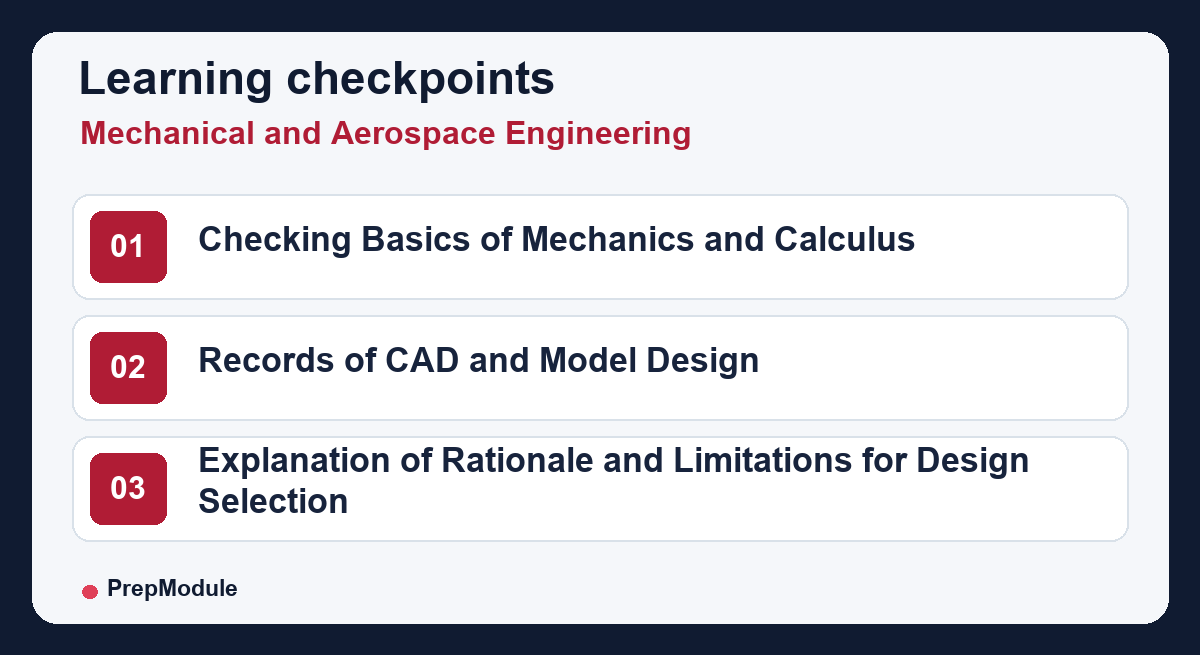
You can start with a topic like a paper bridge or a simple structure seen in school science class. Compare various types of classroom models to observe what changes when the same amount of material is used, and if the measurements differ from expectations, consider the reasons. Limit the load to a safe educational range under the supervision of a teacher. Students interested in CAD can keep a record of their design by changing the model's dimensions or comparing designs through light visualization.
If you are in the aerospace field, a small-scale project would be good, such as reading astronomical and meteorological data released by NASA or educational institutions to study environmental differences based on altitude, or explaining curriculum content on flight principles using safe classroom models and graphs. You do not need to build dangerous propulsion devices or high-energy equipment yourself to demonstrate suitability for the major.
What competitions and activities are relevant?
The FIRST FTC/FRC team offers the opportunity to experience mechanical design or building safe on-campus robots. If a student has independently selected a topic and developed their design and research, they can look for opportunities to present at local science fairs. Taking on a collaborative design role in a school-level engineering design club is also a good start. Rather than spending a lot of money on equipment with the goal of entering international competitions from the beginning, I recommend that students first gain experience interpreting observations using their own knowledge.
What should be recorded in a design journal?
Organize at least one or two pages of original requirements, draft drawings, observation data, causes of failure, modifications, and remaining issues. Also, specify the role the student played among friends—whether it was design, fabrication, or documentation. This helps them remember which actual problems they solved when explaining the experience later.
Comparing Mechanical Engineering and Aerospace Engineering as College Courses
While an understanding of mathematics, physics, and mechanics is important in both fields, the emphasis of the major courses may differ. In Mechanical Engineering, you encounter a broad range of fields such as materials, thermodynamics, fluids, manufacturing, and mechanical design, while in Aerospace Engineering, you can study theories regarding flight-related fluid phenomena, structures, and space systems in greater depth. Check the course catalogs of your target universities to see the advanced fields you can choose after completing basic mechanics courses.
Even students interested in the shapes of airplanes or cars will find that actual university coursework involves explaining physical phenomena using mathematical formulas and comparing various design requirements. You can establish criteria for choosing a major by first considering whether you find structures and materials interesting, kinetic and energy analysis interesting, or numerical modeling interesting.
Examples of producing safe design activities as deliverables
You can consider activities where you compare different shapes on paper or general educational models under the guidance of a teacher. For instance, this involves observing qualitative differences in stability before and after changing the shape of a structural model and recording which comparison conditions were kept constant. You must adhere to school safety guidelines, and there is no need to build high-energy devices or actual flying devices.
Include your initial idea, constraints, what differed from expectations, what was verified in the model, and the limitations of applying it to the actual structure in your design records. Even CAD work viewed only on a screen serves as a good foundational activity if you organize the reasons for the design and the change history.
Things to Consider When Choosing Engineering Courses
Ensure you can accurately handle functions and vectors in mathematics, and explain the relationship between force and motion in physics using words and graphs. Courses such as AP Calculus, IB Mathematics AA, and A-Level Mathematics and Physics require you to consider both university requirements and the options offered by the school. You do not need to decide on every engineering field while in high school. Try to steadily develop an interest in one or two fields through foundational courses and various safe design experiences.
What Should Students Considering Mechanical or Aerospace Engineering Prepare?
Comparing School Courses with Majors
We review your current level in functions, vectors, calculus, and physics, as well as the engineering course requirements for each university. Understand the academic content regarding the various design fields of mechanical engineering and flight and space systems in aerospace engineering, and compare it with your own interests.
Activities for students to explore firsthand
Learn the meaning of models, measurements, and conclusions through activities such as comparing shapes and material quantities in safe educational CAD models or observing the stability based on the shape of paper structures. There is no need to purchase advanced equipment from the start.
Class & Counseling Connections
You can discuss basic physics and mathematics and preparation for school subjects through tutoring, and directions for major and activity selection during one-time admissions counseling, allowing you to request only the areas you need.
For both mechanical engineering and aerospace engineering, it is beneficial to experience the process of designing and reviewing using mathematics and physics rather than focusing solely on the 'made object' itself.
Official resources
Consultation on Preparing for Mechanical & Aerospace Engineering
PrepModule is an educational service that supports both international school curriculum classes and university admissions. We have tutors in Math, Physics, and Coding who majored in Computer Science at MIT, and we identify teachers suitable for the student's school curriculum and requested subjects.
You can apply for only the subjects and units you need, as many times as you want, without having to pay for a fixed package.
If you let us know your current math and physics studies and engineering projects of interest, we can discuss coursework and activities suitable for your grade level and proficiency.
