Academic competitions & Olympiads
U.S. Science Olympiad pathways: F=ma, USAPhO, USNCO and USABO
Compare U.S. Physics, Chemistry and Biology Olympiad pathways, eligibility, exam formats and safe academic preparation for international-school students.
High school science and engineering competitions include Olympiads in Physics, Chemistry, and Biology. It is important not to assume that just because the competition name includes "U.S.," any school can participate, or that taking the first exam guarantees advancement to the international competition. Let's summarize the characteristics of the three paths.
Eligibility for the first exam and eligibility for selection to the U.S. delegation may differ.
Physics: F=ma and USAPhO
This is the selection path for the U.S. Physics representative operated by the AAPT. The F=ma exam focuses on mechanics, while the USAPhO is a higher-level exam that evaluates more advanced physics problems. Official AAPT regulations state that F=ma candidates must be U.S. citizens, permanent residents, or students currently enrolled in U.S. schools who meet the relevant requirements and must be located within the United States. The USAPhO exam stages are subject to separate requirements regarding U.S. citizenship or permanent residency and U.S. eligibility. Additional conditions also apply to camps and the selection of international representatives.
Chemistry: USNCO
This is administered by the American Chemical Society (ACS). It is a U.S. selection pathway that progresses from the Local Exam to the National Exam and Study Camp. Current guidelines specify requirements such as U.S. high school grades 9–12, age, and graduation date. Students without U.S. citizenship or permanent residency may take the Local Exam depending on the conditions, but they cannot receive recommendations for the National Exam. Additionally, there are separate regional and status rules for students attending U.S. schools abroad. Please check first which ACS region or operating organization your school belongs to.
Biology: USABO
This is the U.S. Biology Olympiad pathway run by the Center for Excellence in Education (CEE). Students selected after two examinations proceed through the National Finals and compete for selection for the U.S. team. The program is centered on U.S. schools; check the official USABO registration rules for the relevant season for overseas school eligibility, advancement requirements, and national team eligibility. Not every international-school student is eligible to compete for U.S. team selection.
| Field | US Programs | Points to Check Specifically |
|---|---|---|
| Physics | F=ma / USAPhO | Test Locations and Status Requirements for Initial and Advanced Levels |
| Chemistry | USNCO | Difference between Local and National, ACS Regional Registration |
| Biology | USABO | School Registration and Selection Requirements for Relevant Levels |
IPhO, IChO, IBO International Competitions
The International Physics Olympiad, International Chemistry Olympiad, and International Biology Olympiad are international competitions in which national delegations participate. These are not competitions where individual students can choose their desired national representative status. You must contact the official selection agency in Korea or your current country of residence to verify eligibility, schedules, and how to participate through your school.
To Students Starting Preparation
For students interested in the Olympiad, it is best to thoroughly study the basic concepts learned in your school's science and mathematics curriculum above all else. Try to explain the concepts and formulas accurately while reviewing the solutions. If you are unfamiliar with competition preparation, you can check whether you can approach the official example problems or the scope at your current level. Conducting dangerous experiments on your own is not part of competition preparation.
How to Check Basics by Subject
Students interested in physics problem-solving should try explaining concepts learned in textbooks, such as force, motion, and energy, using formulas, diagrams, and words. In chemistry, you can verify your basic understanding of moles, chemical formulas, and particles through concepts and calculation problems on paper. In biology, it is also useful to practice distinguishing between theoretical explanations and the differences presented in materials after reading concepts such as ecology and cells from your school curriculum. There is no need to conduct university-level research or dangerous experiments right from the start.
When participating in any competition, it is more important to be able to accurately explain subject topics you currently understand than to encounter many of the most difficult advanced problems. Refer to the publicly available learning materials and past practice problems provided by the official organizing body, and distinguish whether an incorrect answer is a simple calculation error or a misunderstanding of the concept.
Be sure to verify your school's location and national representative eligibility separately.
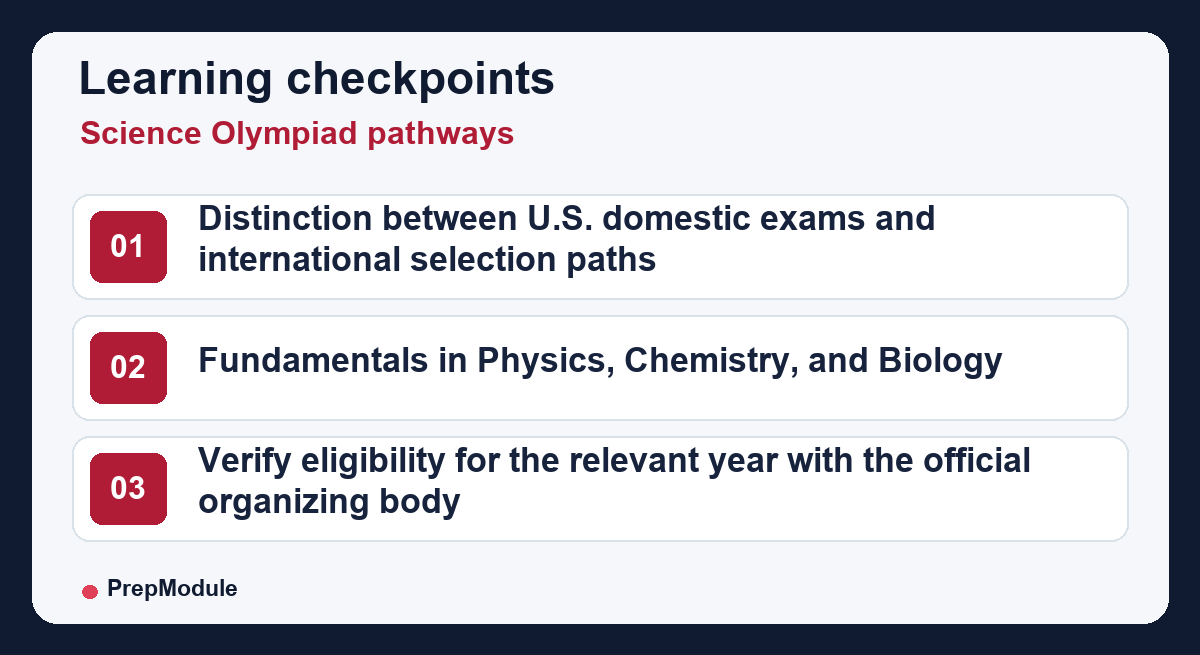
For U.S. national programs such as F=ma·USAPhO, USNCO, and USABO, the requirements for participating in the actual first exam may differ from those for subsequent selections. It is difficult to determine eligibility based solely on the information that you are an international school student. You must compare the school's location, registration method, citizenship or residency status, and the student's grade level with the regulations for each stage provided by the official organization. Since international competitions such as IPhO, IChO, and IBO generally involve official national representative selection procedures, please be careful not to misunderstand that individual students apply directly to the international finals.
Students attending international schools in Korea or abroad can look for official competitions or extracurricular activities held in their respective countries and regions. It is not mandatory to prepare for specific U.S. competitions that are unregistered; students can start by deepening their understanding of school subjects according to their desired learning direction.
Set only two goals per semester
Set specific learning goals, such as understanding particular subject units and reviewing public practice problems. Students eligible to register for exams determine their preparation time by comparing their academic schedule with the official competition schedule. It is important to consider safety and the appropriate level of learning, and to observe whether the student's understanding and ability to explain concepts are steadily improving.
Preparing for Science Olympiads tailored to the student's academic foundation
Review qualifications and levels
The participation requirements for F=ma, USAPhO, USNCO, and USABO regarding grade level, nationality, school, or region vary. Compare the announcements from your school teacher and the official organizing body to determine which competitions you are eligible to participate in.
Preparation Focused on Curriculum Concepts
For Physics, review mathematical and kinematic concepts; for Chemistry, review curriculum theories and general quantitative problems; and for Life Sciences, review textbook concepts and data interpretation. Instead of solving only difficult competition problems from the start, study according to your level, progressing from basic to advanced.
Selecting Necessary Subject Classes
If you provide the public problems the student has solved and the school's subject scope, we can discuss theory and problem-solving classes for specific science or mathematics subjects. Prepare by focusing on safe curriculum learning rather than dangerous personal experiments.
Instead of the competition's name or reputation, verify the level of academic readiness and actual participation you are capable of.
Official resources
Inquiry about Science Olympiad Classes
PrepModule offers international-school tutoring, SAT and TOEFL preparation, competition preparation, and U.S. college admissions counseling tailored to each student. Our tutors include an MIT computer science major and a research and writing tutor pursuing a PhD in Political Science at LSE. We check tutor availability and scheduling for your requested subject.
Instead of packages that include unnecessary classes, you can select subjects and class durations based on the student's situation.
Please let us know the target field, the student's grade level, current subjects, and competition experience. We will provide consultation on the science subjects and competition preparation classes necessary for the student's current level.
