IB Extended Essay (EE): choosing a focused research question
Choose a feasible research question, organize sources and plan independent writing.
When preparing for the EE for the first time, some students are unsure which to choose because there are too many fields of interest, while others choose a topic that is too broad from the start.
The Extended Essay is not a report that explains everything about a single field. It is a process of formulating your own questions and answering them.
You Need a Question That Can Investigate, Not Just Interest
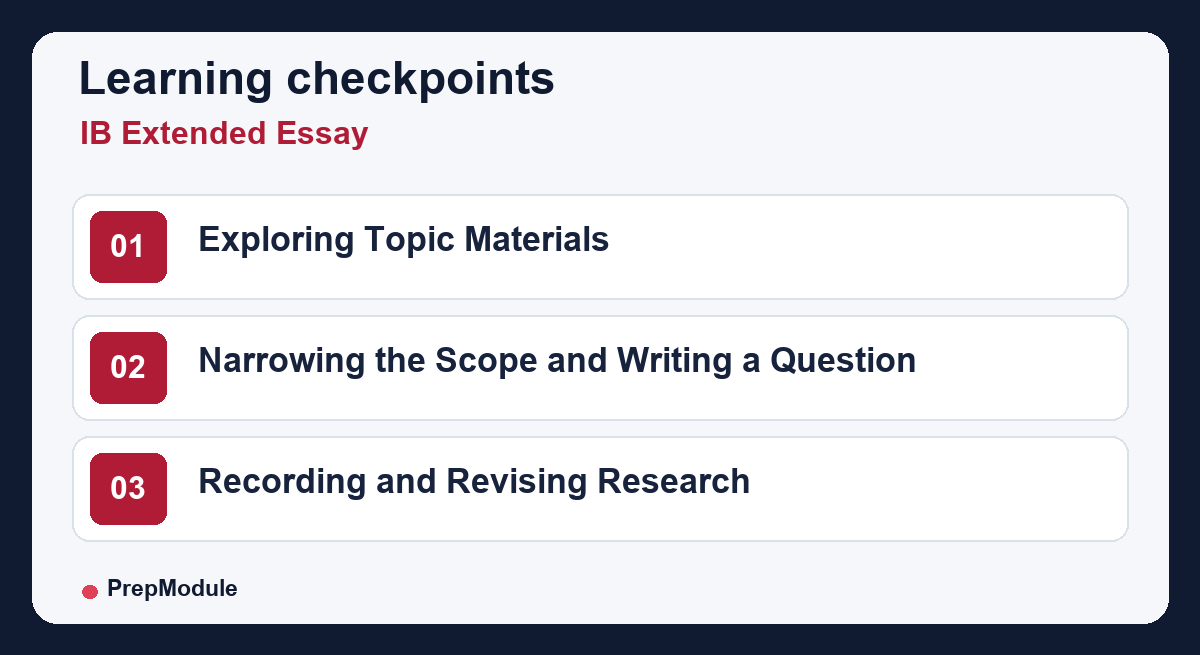
If you are interested in a topic, look for materials first.
If there is a book or phenomenon you want to read about or explore, you can determine the direction of your questions by checking several reliable sources. You must check the subject-specific EE standards and guides relevant to the exam year with your academic advisor.
If you choose a question for which it is difficult to access materials, there is a high probability that you will get stuck during the essay writing stage.
For example, if you are a student interested in literary works,
rather than investigating themes appearing in every work by a single author, you can explore one or two works by focusing on specific expressions or character changes.
Narrowing the scope in this way makes it easier to cite specific evidence in the text and explain why your interpretation is valid.
Keeping a record makes editing easier in the EE
While reading materials, make separate notes on sources, key arguments, and reasons that support your research question. Even after receiving feedback from your advisor, you must decide on your own questions and arguments and write them.
Examining how your thoughts and evidence changed during the writing process is an important experience in the EE.
A small test to check if it is a good Research Question
For example, the question "Why is public transportation important in a city?" is too broad, and the amount of data required to answer it can become endless. Students using publicly available statistical data can clearly define the location, period, and comparison items, such as "What differences appear in the frequency of public transportation operation during rush hour in two specific regions?" Rather than deciding what you want to argue first, you should verify whether the actual data can answer the question.
Record materials and limitations before writing the outline
Record the title of the material, author or publisher, relevant pages, and the reason for the connection to the question in a table. Subsequently, you can organize the meaning of the research question in the introduction, the evidence and analysis in the body, and the answer to the question and limitations in the conclusion. You must check the exam year and the school's official guide regarding the EE evaluation method. While you should refer to the supervisor's feedback, it is important that the student writes the content themselves and cites accurately.
How to get help step-by-step when stuck on the EE
Checking the scope of the question
Review the topics the student is interested in, elective courses, and available materials. You can discuss mentoring to help narrow a broad topic into a single comparable question and verify the school advisor's guidelines and the evaluation criteria for the relevant courses.
Reading Materials and Constructing Arguments
After evaluating the reliability of sources and reading the materials, students structure their own arguments and supporting evidence. You can also ask about relevant lessons with our research and academic writing tutors, including a tutor pursuing a PhD in Political Science at LSE.
Independent Student Writing
This class focuses on learning concepts, data interpretation, and feedback so that students can revise their work themselves, rather than having questions or papers created on their behalf. Please inquire only about the steps necessary within the school's EE guidance policy and academic integrity standards.
Recording and Revising Research
Official resources
From EE Topics to Research Questions
At PrepModule, you can discuss your learning needs with subject tutors, including a research and academic writing tutor who is a PhD candidate in Political Science at LSE and an Oxford researcher, and a tutor majoring in Computer Science at MIT. We aim to help students formulate their own questions and develop their own research skills.
You can selectively request only the necessary steps and classes without a fixed long-term package.
Please let us know your current EE subject, topics of interest, and how far you have progressed. You can discuss the necessary learning mentoring to help you conduct your own research and complete your writing.
