How to start high-school research: questions, reports, posters and papers
Learn how to choose a focused research question, read reliable sources, conduct safe student-led inquiry and communicate findings in reports and posters.
You will frequently encounter the term "Research" when planning extracurricular activities for international school students. As parents, it is natural to have questions such as, "How is research done for a high school student?" or "Is it absolutely necessary to write a paper with a university professor?" Understanding the flow of research allows you to determine more realistically what can be done first in the current grade level.
Step 1: Turning Your Topic into a Question
If your field of interest is simply defined as 'transportation,' your research question is not yet specific. For example, you could read publicly available city bus operation statistics and compare how the frequency of service differs by time of day or region. Instead of asking a question that is too broad, such as "Why can all transportation problems be solved?", it is better to think about what you can actually find out using the non-sensitive public data available to you.
Step 2: Reading Existing Materials and Research
Identify the definitions and sources of the data in relevant textbooks, explanations from public institutions, and existing academic papers. Summarize what questions previous research on your topic of interest asked and what conclusions it presented. Also, distinguish how your own inquiry differs from previous research. You must not simply copy and paste sentences or create citations without properly understanding the arguments in the original text.
Step 3: Determining Feasible Scope and Research Ethics
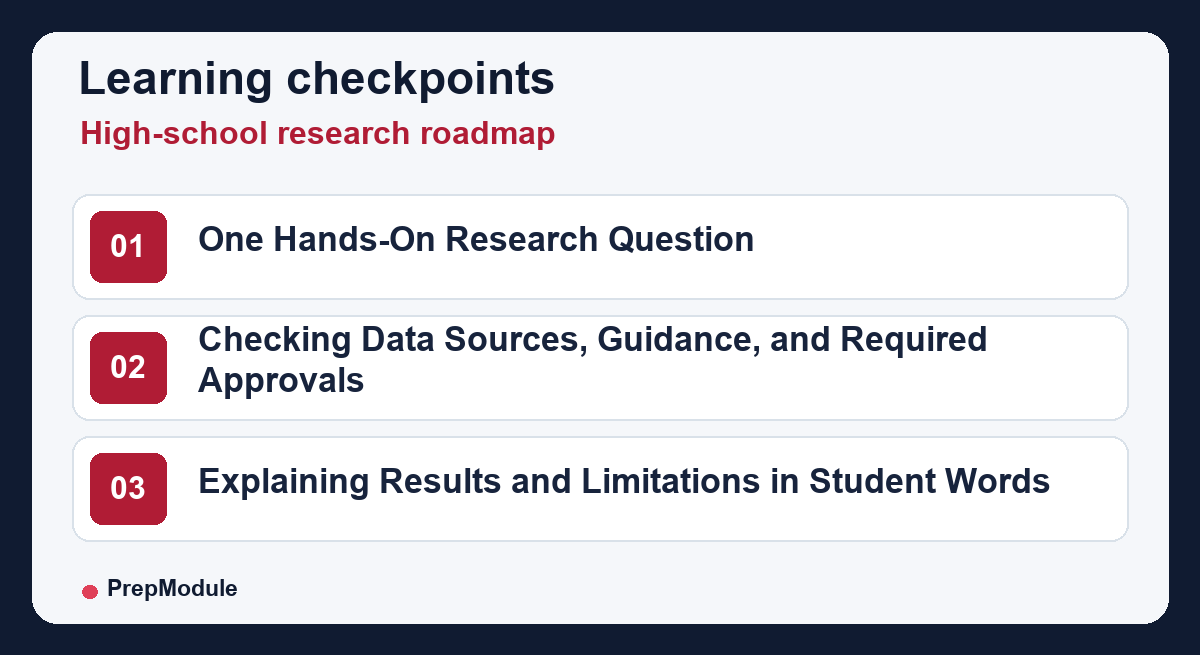
Consider the scope within which the data can be used, the amount of time and mathematical/statistical methods that can be employed, and the guidance the teacher can provide. Verify the data sources, permitted usage scope, and the absence of personal information. Inquire with the supervising teacher or institution regarding the formal approvals required for the research process. Do not conduct dangerous or sensitive research independently. If you intend to submit to an accredited Science Fair, you must read the official regulations for that year before starting.
Rather than focusing on how difficult the research title appears, first examine whether the question is something the student can understand and explain on their own.
Step 4: Recording Limitations of Data and Results
For a safe, open-source project, record basic details such as data units, sources, survey periods, and missing values. For example, if you discover differences in public transportation statistics by region, you must acknowledge that the data aggregation method or other variables may have also had an influence. Deleting parts without justification or altering them to resemble different results simply because the data differs from your expectations is not permitted. It is recommended to keep a record of your files, sources, and revision history from the beginning.
Step 5: Select Report, Poster, or Paper Format
| Deliverables | Features | Who will benefit? |
|---|---|---|
| Research Report | Document the question, methods, results, and limitations | Classroom and on-campus inquiry |
| Research Poster | Present key data using figures and tables and engage in Q&A | On-campus presentations, qualifying competitions |
| Literature Review | Synthesis of claims, evidence, and differences from existing research | Literature-based learning |
| Journal Manuscript | Writing in journal format, official review and evaluation | Research that meets submission requirements |
Not all deliverables are strictly necessary. An on-campus presentation alone can be a valuable experience for understanding your question and explaining it to others. Journal submissions and science competitions may have separate criteria regarding independent research, author eligibility, and research approval.
What is the role of a supervising teacher or research mentor?
Mentors can guide students in their study direction and ask important questions when interpreting data and results. Having a mentor research topics you are unfamiliar with and complete the writing on your behalf cannot be considered a student's own activity. You must distinguish between what support you received for your research and what you actually did, and disclose your findings in accordance with competition, journal, and school regulations. If your subject knowledge is still lacking, it is better to supplement your studies in related subjects first rather than rushing to prepare for research.
Research Preparation by Grade
In grades 7 through 9, read various materials related to topics of interest and try explaining them using tables or figures. Around grade 10, you can plan small, safe, open-source projects connected to the curriculum with your teacher. In grade 11, explore questions at length to accumulate reports and feedback regarding data and results, and in grade 12, accurately summarize the research you have conducted and its limitations. You do not need to conduct external research at the expense of your academic studies or other activities.
How should I write research notes?
Imagine a student starting a hypothetical inquiry using publicly available regional traffic statistics. In the first column of the record sheet, write the question to be investigated and the source of the data; in the next column, write the items and units provided by the data; and in the third column, write the characteristics observed in the data and the limitations of its interpretation. If there are missing values during the analysis, do not modify the data or fill them in arbitrarily; instead, record the reason and the potential impact on the interpretation. Even if the results differ from initial expectations, explain them as they are and connect them to the questions to be investigated next.
The reason for keeping research notes is not to embellish the final result to make it look better. It is to accurately show what information the student used to modify their thinking from the initial question, what they understood firsthand, and where they needed help from others. Where the data was obtained is also important information for writing the deliverables later.
Example of a 6-Week Safe Curriculum Inquiry Study Schedule
In the first week, read textbooks and publicly available learning materials in the field of interest and write down several possible questions. In the second week, select a question with a defined scope that allows for the use of actual data, and review the use of data and the scope of the research under the guidance of your school teacher. In the third and fourth weeks, you can focus on reading non-sensitive public data, organizing necessary tables and figures, and understanding the meaning of the indicators to be compared.
In the fifth week, write a draft explaining the results and limitations in your own words, and in the final week, after receiving feedback from your teacher, organize it into a presentation and report. You can adjust the timeline to accommodate your schedule, but if there are actual school assignments, competition regulations, or research approval requirements, those standards take precedence. This schedule is a general example to aid learning and does not imply the permitted research period for any journal or international competition.
Think of presentations, papers, and admissions activities separately.
In presentations, you can focus on clearly conveying the key question, findings from the data, and the meaning and limitations of the results to the audience. For research posters, it is important to appropriately arrange figures, tables, and brief descriptions, while written reports must sufficiently explain the background of the question and the materials used. Since journal submissions and competition participation involve separate eligibility, approval, copyright, and review procedures, do not consider them finalized plans until you have confirmed that the student meets the requirements.
When explaining activities for college admissions, you must be able to accurately articulate the questions you solved and what you learned, rather than focusing on the fact that you gave a presentation or your big name. Try to distinguish between the parts you wrote or analyzed yourself and the parts that your mentor suggested or assisted with. For students starting research for the first time, simply defining a question and reading course materials is a meaningful first step.
Step-by-step lessons needed for students starting research for the first time
Narrowing the student's interest to a question
When conducting the initial consultation, please organize the school curriculum, current grade level, subjects of interest, and the question the student has come up with on their own. For example, if the student likes urban transportation, review what public statistics they can read and whether the subjects of comparison and time periods are clear.
Foundational learning necessary for research
We can discuss mathematics, statistics, coding, or academic reading lessons to help students understand key concepts and interpret tables or graphs. Ask about relevant guidance from research and writing tutors, including a tutor pursuing a PhD in Political Science at LSE.
Students Explaining Results Directly
Develop the ability to distinguish between facts verified in materials and the student's own interpretation, and to organize answers to research questions, constraints, and references. We do not promise the production or publication of deliverables; you can request classes that cover only the concepts and writing instruction currently needed.
Publication or winning international competitions does not need to be the goal from the start. Good questions, honest interpretation of materials, and the student's understanding are the starting points of research.
Official resources
If You Are Starting Research for the First Time
At PrepModule, you can discuss your learning needs with subject tutors, including a research and academic writing tutor who is a PhD candidate in Political Science at LSE and an Oxford researcher, and a tutor majoring in Computer Science at MIT. We aim to help students formulate their own questions and develop their own research skills.
You can selectively request only the necessary steps and classes without a fixed long-term package.
Please let us know the topics you are currently interested in and your academic and research experiences. We will provide mentoring consultations to help you refine your questions, read materials, and conduct your own research.
