RSI 2027 Research Science Institute: MIT and Stanford application, eligibility and preparation
Review the 2027 RSI dates, U.S. and international eligibility, selectivity, recommended scores, application materials, essays and preparation.
If you are a parent considering STEM fields at a U.S. university, you have likely heard of the Research Science Institute (RSI) as a research program available to high school students. The recruitment schedule for the 2027 RSI, which will be held at Stanford in addition to MIT starting this year, has been announced. Students preparing to apply need to review the materials and eligibility requirements they must prepare now, while 9th and 10th graders need to examine the academic foundation they need to build going forward.
Based on the official announcement for CEE for 2027, let's examine the actual program details, selection criteria, and how to prepare for the application.
RSI 2027 Recruitment Schedule and Program Structure
This selective research program is run by the U.S. nonprofit Center for Excellence in Education (CEE) in collaboration with MIT and Stanford. Over six weeks, students attend STEM classes and undertake individual research with a mentor, concluding by presenting and writing up their findings. Unlike a conventional summer school focused on coursework, RSI centers on developing an individual research experience.
| Section | Announcement Schedule |
|---|---|
| US Application Deadline | December 11, 2026, 11:59 PM ET |
| Korea Time Conversion | December 12, 2026, 1:59 PM KST |
| MIT Program | June 20, 2027 – July 31, 2027 |
| Stanford Program | June 27, 2027 – August 7, 2027 |
| Acceptance Notification | Generally March |
After selection, students spend the first week in intensive STEM classes and the following five weeks working with research mentors. Projects and mentors are assigned based on applicants’ academic background and interests, so students cannot simply bring an existing project to continue. Compare the dates for both campuses with your school’s final examinations and summer break.
Can international school students apply?
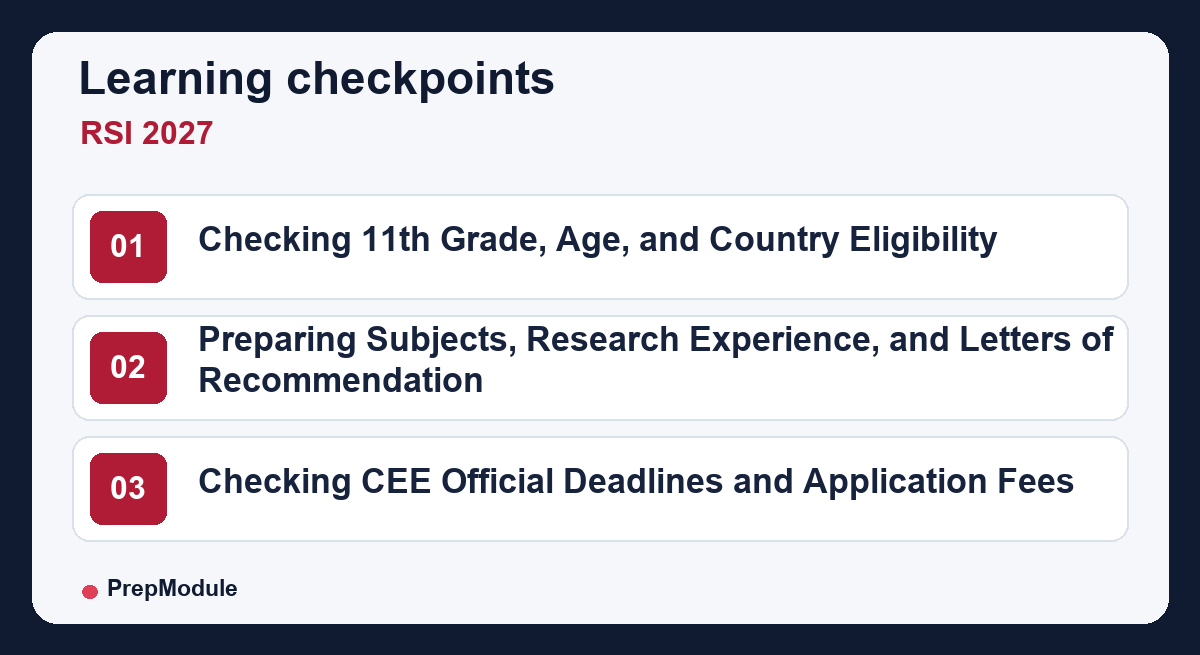
This program is intended for high school students with one year remaining until graduation, generally those currently in Grade 11. If you attend a school outside the U.S., you must verify not only what grade level your school designates but also your actual expected graduation date, nationality, and application path.
| Items | Official Guidelines |
|---|---|
| Grade Level | Students with one year remaining until graduation, typically 11th grade at the time of application |
| Age | 16 years of age or older by July 1 of the program year |
| Eligibility | U.S. citizens, permanent residents, and international students from participating countries |
| Research Experience | Previous research experience is helpful but not mandatory |
| Participation Fee | Education, accommodation, and meal costs are covered by the program |
| Application Fee | $75 based on current FAQ; inquiries regarding waivers are possible depending on circumstances |
U.S. citizens or permanent residents, even if currently enrolled in a school abroad We will review the U.S. application route for direct application to CEE. For international students, separate selection procedures and schedules may exist depending on the participating country and partner organization. Since not all Korean students apply in the same way, please check with the official CEE department regarding participation status for your country.
The program covers the participation fee, which includes education, accommodation, and meals. However, according to the FAQ, the application fee is a non-refundable $75; you can inquire with CEE regarding the possibility of a waiver due to financial need.
What is considered important in the selection process besides grades?
The CEE FAQ states that less than 2.5% of all applicants are selected. It is important for a participant's previous academic background and activities to demonstrate potential for future development in STEM fields, a solid academic foundation in mathematics and science, and experience in striving for self-directed exploration.
The recommended standardized test scores presented in the official application guidelines for U.S. students are as follows.
| Test Section | Recommended Scores |
|---|---|
| PSAT Math | 740 or higher |
| PSAT Reading and Writing | 700 or higher |
| ACT Math | 33 or higher |
| ACT Verbal | 34 or higher |
The FAQ lists SAT Math scores of 750 or higher as an example of a recommended score. However, this number does not mean it is the minimum admission score or the cutoff for acceptance. In addition to scores, the entire application—including the student's academic record, letters of recommendation, and science activities—is reviewed, and international students must also check the test score recognition methods of their respective countries. It would be advisable to start by organizing the difficulty level of the courses currently offered by the school.
What should I prepare if I have no research papers or university research experience?
According to CEE, approximately 10% of past RSI participants had no prior research experience. However, this does not mean that simply stating an interest in STEM is sufficient. You need concrete experiences that demonstrate which fields the student wanted to learn about and how that interest developed into learning.
For example, a student who enjoys mathematics could compare two simple mathematical models after studying a unit on functions while reading temperature change graphs from publicly available weather educational materials. A student interested in computer science could solve publicly available practice problems or write small programs for actual use and compare the results with different inputs. It does not necessarily have to be an activity involving participation in a university research lab.
Initially, read textbooks and publicly available academic materials in your field of interest and record which problems you already understand and which parts you are more curious about. It is also important to develop the habit of distinguishing between the core arguments of the materials you read and your own thoughts when explaining them. If the results of your inquiry differ from your expectations, you must be able to ask yourself why you think that way. We do not recommend hastily writing a paper solely for the purpose of applying for a research program or recording activities that were not actually performed.
How do I prepare the application materials?
According to CEE’s official application page and FAQ, applicants submit academic records, essays, recommendations, and information about relevant activities. The Apply to RSI page describes two recommendations from teachers or research mentors, with a maximum of three; the FAQ refers to three letters. It is therefore important to confirm the precise requirement in the applicable application form.
| Materials | Content to prepare in advance |
|---|---|
| STEM Essay | Specific interests, what was learned, and questions attempted to solve independently |
| Transcript | Courses completed and official grades from school |
| Letters of Recommendation | Math or science teachers or mentors who actually know your academic ability and research experience |
| Standardized Tests | Materials required by the specific application path, such as PSAT, SAT, ACT, and AP |
| Activities and Awards | Activity name, your role, and actual learning content |
Please separate items prepared directly by the applicant from those uploaded by the school representative. It is also important to inform the teacher requesting the recommendation of the submission deadline in advance and to confirm the necessary schedule with the school official issuing the transcript. Check to ensure that the duration and role of the same activity do not contradict each other in the essay and activity record.
How to Specify a Student's Unique Interests in a STEM Essay
Let's assume, for instance, that both students like computer science. One student lists the fact that they have taken various courses, while the other student explains how they rethought a problem where they initially produced inefficient code while studying algorithms, which parts they were unable to solve, and what they want to learn further. It is easier to understand a student's experience if they demonstrate a specific learning process, as in the second explanation.
Before writing the essay, try answering the following three questions in your own words. First, what course content or real-world problem were you most curious about? Second, what did you study and attempt to investigate that problem? Third, how has your initial thinking changed from your current thinking? This does not mean you must produce groundbreaking research results. You should be able to explain based on actual experiences, such as concepts newly learned while reading materials or questions you still have not been able to solve.
What if you start preparing in 9th or 10th grade, or what if you cannot apply now?
You can plan by focusing on foundational learning and exploration in math and science in 9th grade, advanced study and small inquiry activities in subjects of interest in 10th grade, and organizing your existing studies and activities in 11th grade while comparing eligibility with the actual program requirements. Of course, this will vary depending on the student's school curriculum and semester schedule.
You do not need to give up on STEM exploration just because you do not meet the eligibility requirements for RSI or were not selected. If you are interested in long-term research in mathematics, compare it with other programs such as MIT PRIMES, and check the eligibility requirements for other summer research programs based on your grade level, nationality, and region. Continuously studying school subjects and areas of interest, or working on independent projects permitted by your school, are also viable options. College admission results are not determined solely by acceptance into selective programs like RSI.
Preparation PrepModule Can Help Students Aiming for RSI
Pre-application Profile Analysis
Consult with former admissions officers from Harvard College and others to organize current STEM courses, grades and test records, math and science activities, and areas of genuine interest. After reviewing CEE selection requirements and the student's application path, determine whether what is needed now is course foundations, advanced study, or preparation of application materials.
Deepening and Exploring Areas of Interest
For example, if you enjoy math and coding, you can compare simple models from public resources, write code, and record your trial and error. You can inquire about necessary computer science and math study with tutors such as MIT computer science majors, and study methods for reading public resources and refining independent research questions can also be discussed on a student-by-student basis.
Organizing Personal Experiences for the Application and Essay
It is important to organize the courses completed, materials read, and activities performed by the student based on consistent facts, and to express in your own words the questions that sparked your interest. Research and academic writing classes are designed to help students think and write independently and follow CEE's regulations regarding external assistance and submission. Requests for recommendation letters and transcript preparation are managed jointly by the student and the school in accordance with official requirements. You may receive admissions counseling first and then separately request necessary courses and study.
Start by verifying program eligibility, and then systematically organize the studies and explorations the student has pursued in their areas of interest.
Official resources
RSI Application and Research Preparation Counseling
At PrepModule, you can discuss your learning needs with subject tutors, including a research and academic writing tutor who is a PhD candidate in Political Science at LSE and an Oxford researcher, and a tutor majoring in Computer Science at MIT. We aim to help students formulate their own questions and develop their own research skills.
You can selectively request only the necessary steps and classes without a fixed long-term package.
Please let us know the student's grade level, areas of research interest, and activities undertaken to date. We can discuss together what academic knowledge and research experience the student will acquire before applying to the program.
