Four journals for high-school research: JEI, JHSS, Young Scientists Journal and Young Scientist
Compare four journals for high-school research submissions, author eligibility, manuscript formats, ethical requirements and academic writing.
High school students sometimes ask, "Where can I submit this paper?" after conducting research. Some people even view paper publication as a mandatory step in college admissions. However, each journal has specific submission criteria, research types, and review conditions, and not all research results must necessarily be published in an academic journal. First, let's look at a few journals that accept submissions from high school students.
Differences between Original Research and Review Article
Original Research is a text containing the problem, methods, results, and interpretation of original research conducted directly by the student. A Review Article critically reads and summarizes various previously published studies. Scientific articles and personal opinion pieces are also different formats. Since not all journals accept these types of writing in the same way, you must first identify the type of writing you have produced. Just because you have created a
file in the format of a research paper does not guarantee publication in a journal. Please check the types of writing accepted by journals and the requirements for student authors.
1. Journal of Emerging Investigators (JEI)
JEI is a journal designed to help middle and high school students present scientific research they have conducted themselves and receive academic feedback. According to official author requirements, applicants must be middle or high school students aged 13 or older, and the initial submission must be made prior to university enrollment. In addition to the student author, a senior mentor meeting the requirements must be included as the final author, and the actual manuscript submission must be made by an adult author. High-end facilities at a research institution are not mandatory.
JEI’s submission guidelines specify conditions such as designated manuscript templates, citations of sources, data, and software, and relevant research approval documents. As of the official payment notice on November 25, 2026, the submission fee is $49 per manuscript and is non-refundable. A limited submission fee support system based on financial circumstances is also provided. Payment or compliance with the guidelines does not guarantee publication in the journal.
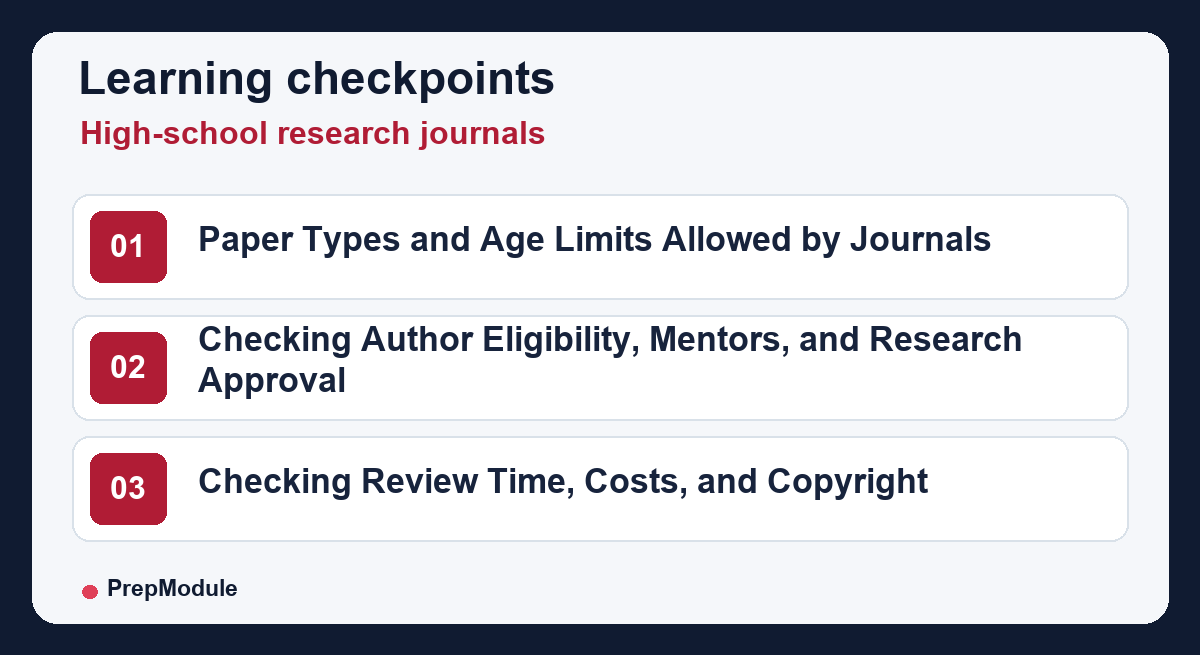
2. Young Scientists Journal (YSJ)
The official website of the Young Scientists Journal introduces submission types, including research by students and young adults aged 12 to 20 at the time of submission, reviews of existing research, and scientific articles. The process involves an initial review and editing of materials, followed by an academic review and final editing. Please note that because the journal is run by volunteers, the review and publication process may take several months. Please check the official Publish Guide for currently accepted fields and source formats.
3. Journal of High School Science (JHSS)
The Journal of High School Science is a journal that reviews research and review papers in the STEAM field by high school students. The official FAQ states that high school student authors are eligible to submit and requests that the roles of the supervising teacher/mentor involved in the research and the actual author be clearly indicated. It informs you that the current submission fee is $95 and is non-refundable, and that a review period of at least one month may be required after submission. Since original articles and reviews each have specific academic standards, please read the journal's latest submission guidelines and previously published articles.
4. Vanderbilt’s Young Scientist
Despite the similar name, Vanderbilt University’s Young Scientist and the Young Scientists Journal are different journals. Young Scientist focuses on communicating original research conducted by high school students at research institutions, with manuscripts reviewed by graduate students and postdoctoral researchers. Read the eligibility guidance about research settings and who can submit before considering it. The Volume 17 submission page listed a December 9, 2026 deadline (verified November 25, 2026). Check the official announcement for the next year’s schedule.
| Journal | Target Audience and Characteristics | Things to Check |
|---|---|---|
| JEI | Middle and High School Students Aged 13 and Older, Student Research | Senior Mentor, Research Scope, Submission Fee, Template |
| Young Scientists Journal | Ages 12–20, Research and Reviews, etc. | Requirements by Format, Editorial/Academic Review Period |
| Journal of High School Science | High School Student STEAM Original Research/Review | Author Role, $95 Submission Fee, Review Schedule |
| Vanderbilt Young Scientist | Original Research Conducted by High School Students in a Laboratory | Relevant Research Environment and Eligibility, Submission Period |
What Should I Check Before Submitting a Paper?
Accurately explain the results and their limitations in accordance with the research question, and ensure that all authors agree on their contributions and the order of authors. If the research was conducted at an institution, you must also check the institution's permission for data use and disclosure, intellectual property rights, and conditions regarding the supervising professor and research approval. You must not fabricate data to resemble other materials or claim others' research as your own. Do not conduct research involving humans, animals, sensitive information, or hazardous materials without appropriate facilities, supervision, and prior approval. You must also verify copyright issues arising from submitting a single manuscript to multiple journals simultaneously or from public disclosure in competitions, in accordance with the specific regulations of each journal.
What are the review results?
After reviewing the manuscript, the journal may decide to request revisions, reject the review, or publish it. Peer Review is a process to examine the validity of the content and explanations; it is not a service that automatically adds your name to the journal. Please examine the official editorial team, submission rules, actual published papers, the review process, and the fees and copyright policies to ensure clarity. You should be particularly cautious of notices promising guaranteed publication within a few days if you pay a large fee.
The Meaning of Publication in High School Research Activities
School science presentations, internal reports, research posters, and journal publications are distinct outcomes. You can gain valuable research experience even without choosing journal publication. When writing college applications, it is important to accurately describe what problem you came to understand and what role you played. There is no reason to rush into research or exaggerate results solely for the sake of publication.
How to Align the Purpose of a Journal with the Manuscript Type
If a student directly analyzes publicly available traffic statistics and organizes the results and limitations according to their own questions, it can be considered a report containing original data analysis. Conversely, if the text compares the arguments of various previously published articles and papers and synthesizes the learning content on the topic, it may be closer to a review format. You must accurately classify the activities you performed to find a journal that matches your manuscript. If the content of the manuscript does not match the research type, it is inappropriate to forcibly change the format and call it original research.
For example, JEI requires verification that the student research meets author eligibility and submission scope, and that a compliant adult mentor is involved. YSJ provides guidance on review and article types in addition to original research. Since JHSS and Vanderbilt Young Scientist also have different author and manuscript requirements, compare actual published articles with the official submission guidelines of each journal. It is a different approach for a student to choose a journal open to young authors to explain their writing than to write a piece with the journal's name as the sole objective.
Let's understand the components of a manuscript
In a typical research report, the title and abstract reveal the question and main results, while the introduction explains the background of the question or necessary concepts. The analysis section of the body distinguishes the publicly available data used, the methods applied for comparison, and the content that can be stated from the results. The discussion and conclusion allow for the explanation of the results' implications, alternatives, and limitations, and the references list the sources of the actual materials used. The exact manuscript structure, word count, and citation style may vary depending on the journal's official template.
If you are a student writing a literature-based review, simply collecting a large number of paper titles is not enough. Establish common questions to organize how the conclusions of different sources differ and what evidence supports them. Explain the content of the materials in your own words and cite sources when quoting directly. The official YSJ Publish Guide provides information on pre-submission requirements, such as article types and specific citation styles, so please check the relevant formats.
Misunderstandings Arising During the Review Process
Submitting to a journal is completely different from having your work accepted for publication after the review process. Statuses such as Submitted, Under Review, Revision Requested, Accepted, and Published can be distinguished based on the stage of progress. If you receive a request for revision, record what feedback was provided and how you understood it to determine whether you are making responsible revisions. Editing, academic review, proofreading, and publication schedules vary by journal.
Paying a fee does not guarantee publication, and you should not blindly trust advertisements that guarantee publication within a short period. Do not assume that the submission fees seen in previous posts represent the current amount; instead, examine the journal's official payment guidelines and any exemption or support programs. It is important not to exaggerate the progress of research results or the review process in order to align with the student's college admissions schedule.
Things Students and Mentors Should Check Before Submission
Check whether you have permission to use the research materials, whether sources and author contributions are accurately indicated, and whether the rights and citation conditions of previously published materials have been adhered to. If the activity was conducted at a school or an external institution, you must check the institution's regulations regarding the scope of publication for the manuscript and materials. Adult mentors can guide students on parts they find difficult to understand during the questioning, analysis, and writing processes, but they do not write the research or manuscript on behalf of the student.
It is also a good approach for the student to first write a research report at school, receive presentation feedback, and then review whether it meets the journal's scope. If the foundation for independent research is still lacking, it is acceptable to build experience starting with relevant course concepts or reading and writing from public materials. The key is not the paper itself, but whether the student can accurately understand and explain their own questions and analysis.
What PrepModule Considers Important When Guiding Students' Thesis/Academic Writing
Checking the Actual Progress of Research
We first review the questions the student established, the materials and sources used, research ethics and school regulations, and what has already been analyzed. It is important to check the official pages for the types of submissions accepted to journals, the qualifications of the supervisor, and the requirements for student authors.
Support for Reading Materials and Argumentation
You can discuss learning how to understand materials and independently organize arguments, results, and limitations with subject-specific tutors, such as a research and academic writing tutor who is a PhD candidate in Political Science at LSE and an Oxford researcher. You can also request basic classes in mathematics, statistics, and coding at an appropriate level as needed.
Journal submission is a process where students receive assistance in understanding and explaining their own work, rather than creating data that does not exist in actual research or assigning the role of author to others.
The aim is to help students understand and explain their own work, not to fabricate data or have someone else act as the author. Students must follow each journal’s authorship, supervision, ethics, and submission rules; publication is not guaranteed.
Prioritize research that you can understand and take responsibility for, as well as the actual review process, over the name of the journal.
Official resources
- Journal of Emerging Investigators · Submission Guidelines
- Journal of Emerging Investigators · Author Eligibility
- JEI · Current submission fees and support systems
- Journal of High School Science · About / FAQ
- Young Scientists Journal · Publish
- Vanderbilt Young Scientist · Article Submission
- Society for Science · ISEF International Rules
Inquiry regarding high school thesis and academic writing mentoring
At PrepModule, you can discuss your learning needs with subject tutors, including a research and academic writing tutor who is a PhD candidate in Political Science at LSE and an Oxford researcher, and a tutor majoring in Computer Science at MIT. We aim to help students formulate their own questions and develop their own research skills.
You can selectively request only the necessary steps and classes without a fixed long-term package.
Please let us know if you have any research you are conducting yourself, reports you are currently writing, or journals you are curious about. You can discuss classes necessary to learn the research process and academic writing methods.
