IB Theory of Knowledge (TOK): moving from opinion to evidence-based argument
Use examples and counterarguments to examine how knowledge is justified in different contexts.
In TOK, even if you write many sentences like "I think this way," it may not be clear what you are trying to show.
In Theory of Knowledge, we must go beyond expressing personal opinions and consider what evidence we use to believe in certain knowledge.
Examining Knowledge Claims from Various Evidences and Perspectives
What does it mean for a claim to be credible?
When you hear a claim, consider not only who said it but also what materials and methods were used to verify it. You can ask on what grounds the claim can be considered correct, and whether the same evidence can be interpreted differently.
Grounds change depending on the field
The way theorems are proven in mathematics differs from the way historical records are used to explain past events. Rather than concluding that one side is superior knowledge, it is helpful to examine the criteria by which each gains credibility.
Using concrete examples allows you to address even very abstract topics more clearly.
When introducing different perspectives, do not stop at simply opposing them
After establishing a claim, write down the conditions under which it can be applied. Compare the grounds while considering why the conclusion might differ from a different perspective.
The process of students researching and interpreting examples themselves is the core of TOK; please check your exam year's guide for the relevant assessment format.
Even with the same material, the process of becoming knowledge can differ.
For instance, imagine reading an old map as historical data or using it as a guide for current traffic routes. In history, who created the map and for what purpose is important, whereas in current navigation, accuracy and timeliness are crucial. A single piece of data can be useful in two different situations for different reasons. In TOK, we consider not only what the evidence is but also why its role changes depending on the question and context.
Connect arguments with comparative perspectives.
For example, in response to the hypothetical question, "Is knowledge expressed in numbers more reliable?", you could argue that comparisons are easier when measured numerically. On the other hand, there is a counter-perspective that if the concept being measured is not properly defined, the numbers themselves can lead to misunderstandings. After comparing the valid reasons and scope of application for each, develop your own judgment regarding the question. In the actual evaluation, you must follow the official title for each session and school standards.
If TOK feels abstract, review the argumentation together.
Analyze the meaning of school questions.
Check the prescribed title or exhibition prompt received by the student and distinguish between key terms and knowledge-related questions.
Develop arguments from concrete examples.
For example, explain why two people interpret data differently and examine how the quality of evidence and perspective influence knowledge claims. You can discuss a writing class where students discuss whether their case actually aligns with the claim and whether there are opposing viewpoints.
Students complete the writing themselves.
This is a class where students learn question interpretation, logical structure, and the relationship between cases and evidence within the framework of TOK school guidance regulations. Students organize and write their own thoughts, and can select only the necessary concepts and writing instruction.
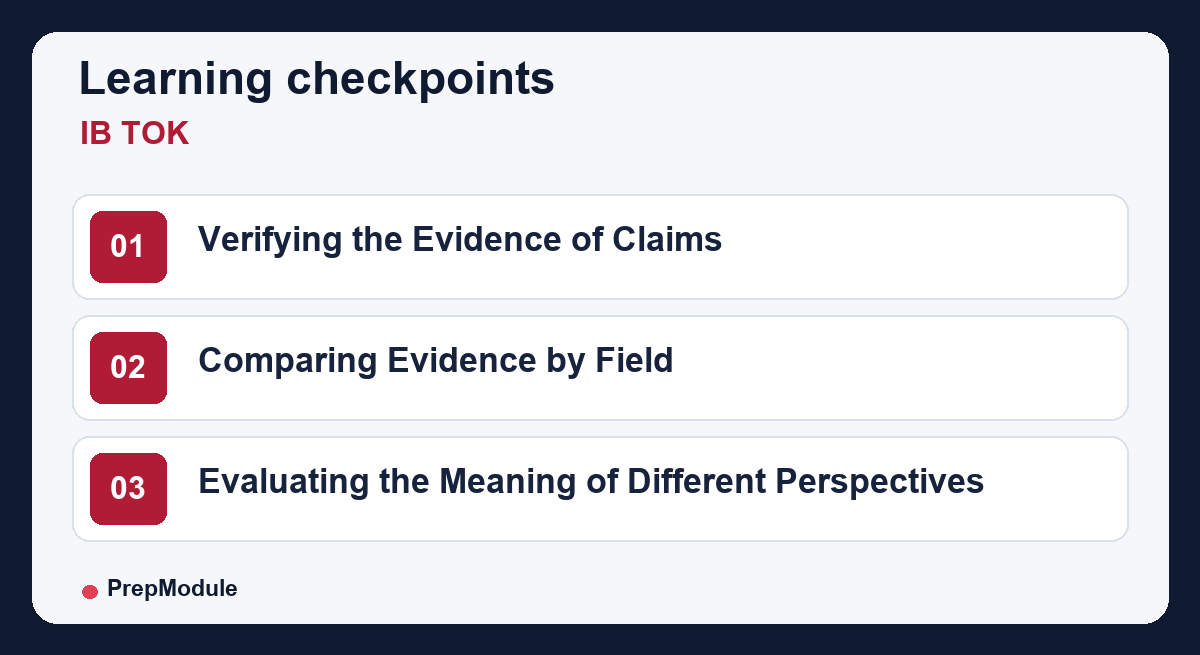
Evaluating the Meaning of Different Perspectives
Official resources
Consultation on TOK Exhibition & Essay Preparation
At PrepModule, you can discuss your learning needs with subject tutors, including a research and academic writing tutor who is a PhD candidate in Political Science at LSE and an Oxford researcher, and a tutor majoring in Computer Science at MIT. We aim to help students formulate their own questions and develop their own research skills.
You can selectively request only the necessary steps and classes without a fixed long-term package.
Please let us know what questions you are concerned about regarding the TOK Exhibition or Essay. You can discuss writing classes that help students develop their own evidence and arguments.
