Preparing for Civil and Environmental Engineering or Urban Planning
Explore civil engineering, environmental engineering and urban planning, relevant subjects, public-data projects and high-school course selection.
If you are a student interested in architecture, transportation, or environmental issues, do not limit your search to Civil Engineering; compare it with Environmental Engineering and Urban Studies and Planning. It is helpful for understanding which departments are interested in the problems we see around us every day.
What do the three majors focus on?
Civil Engineering focuses on the engineering necessary to design and maintain social infrastructure, such as transportation, bridges, water resources, and construction. Environmental Engineering is a field that studies and solves problems related to water, air, and resources through engineering. Urban Planning considers the planning of people and regions together, including the use of urban space, housing, mobility, and institutions. In some schools, Civil Engineering and Environmental Engineering are run within the same department, while Urban Planning is sometimes affiliated with a separate college.
Even the same 'transportation problem' can be approached through different questions, such as road design, environmental impact, and public transportation accessibility.
Which subjects are helpful at international schools?
Math and Physics form the foundation of engineering. If you have a strong interest in the environment, you can encounter new topics in elective courses offered by the school, such as Chemistry, Geography, and Environmental Systems and Societies. Social Science Writing and Statistics are also useful for Urban Planning or policy fields. Please tailor your choices based on departmental admission requirements and your areas of interest.
Projects Observing the Surrounding Area
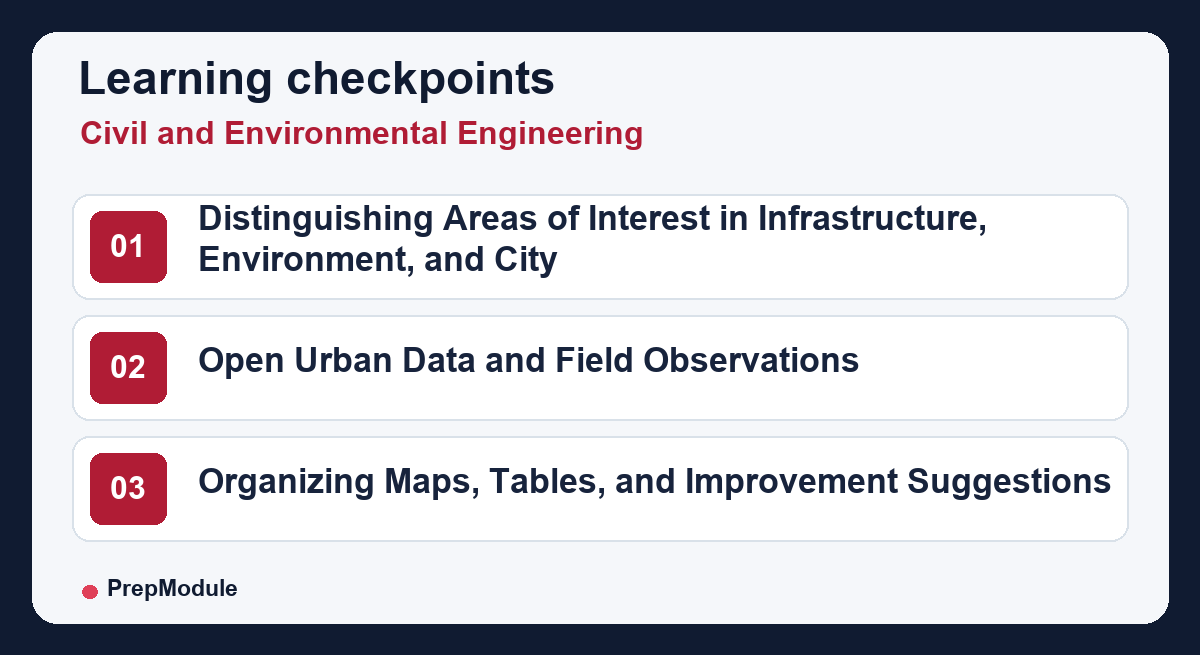
For example, let's explore pedestrian accessibility around the school. Examine bus stop locations, crosswalks, and pedestrian routes using public maps and municipal data, and observe the actual streets while maintaining safety. You can differentiate between information recorded by the student and data obtained from official maps, and organize what is inconvenient on specific routes or sections into tables and figures. There is no need to track people or collect personal information.
If you prefer the fields of climate or environment, you can compare publicly available government weather and air quality data or examine the relationship between public green spaces and regional environmental indicators. The key is not to immediately conclude that a correlation is the cause just because you have found one. Consider what variables might have been missed and whether the analysis period is sufficient.
What about competitions and on-campus activities?
HiMCM is a team competition where participants mathematically model real-world social problems and write reports. It can serve as practice in expressing problems in your areas of interest, such as urban transportation or resource allocation, through mathematics. For on-campus environmental clubs, rather than large-scale campaigns, I recommend the experience of identifying problems that the school actually needs with a teacher and documenting the results over the course of a semester.
Questions to ask when distinguishing majors
Do you find designing spaces interesting, are you more curious about the physical principles of structures, or do you want to read about environmental data and the effects of policies? Depending on this question, you can explore Architecture, Civil Engineering, Environmental Engineering, Urban Planning, and Public Policy in greater depth.
How are classes that study buildings, cities, and the environment different?
In Civil Engineering, you can study the planning and analysis of infrastructure, including structures, soil, water resources, and transportation. Environmental engineering focuses on understanding physical, chemical, and mathematical relationships related to the environment, as well as problems within environmental systems. Urban planning is a field that considers not only the technical design of facilities but also land use, transportation accessibility, urban policy, and social impact. Compare the required courses and projects listed in the university's major overview.
For example, the issue of creating more parks in a city involves structural safety, the environment, pedestrian accessibility, and user needs. Rather than trying to find the answer in a single field, thinking about which specific questions you wish to analyze directly is helpful for exploring your major.
Urban Projects Using Public Data
If a student is curious about pedestrian accessibility in the area surrounding their school, they can consult official public maps to compare the locations of major facilities with the distribution of public transportation stops. Mark the areas identified from public maps and statistical data, and consider that simple straight-line distances may differ from actual travel routes. You can make sufficiently meaningful observations without collecting individual travel routes or addresses.
The deliverables can be a single map, a small table containing comparative indicators, and a report separating the conclusions and limitations derived from the data. For instance, since a large number of bus stops does not guarantee that everyone can use public transportation comfortably, please explain why additional data, such as service frequency or accessibility, is necessary.
Questions to record after selecting an activity
If the student enjoys the relationship between physics and design, they can utilize educational structural models or the school engineering club under the safe supervision of a teacher. If they are more interested in geography and policy, urban surveys and discussions using publicly available data are also possible. By recording what to compare, what data was used, and the limitations of the explanation you proposed, you can more specifically connect the activity with the field of study you will pursue in college.
If you are planning an inquiry suitable for the fields of Urban, Environmental, and Civil Engineering
Identifying Areas of Interest
Organize which issues you are more curious about among transportation networks, buildings, water resources, and environmental policy, and check the differences between departments on the university's official major page.
Activities involving reading data and interpreting models
Read publicly available statistics on regional public transportation usage or urban green space usage and compare units, periods, and regional standards. Record your own questions and the limitations of the data, and learn how concepts from mathematics, physics, geography, and statistics are applied.
Selectable Maps
After discussing your major and course direction during admissions counseling, consult with teachers in your respective fields regarding necessary learning, such as subjects like mathematics and physics, data analysis, or independent report writing skills.
Rather than giving your activity a fancy name, choose a problem from your daily life and explore various possibilities based on available data.
Official resources
Inquiry on preparing for Civil and Environmental Engineering majors
PrepModule is an educational service that supports both international school curriculum classes and university admissions. We have tutors in Math, Physics, and Coding who majored in Computer Science at MIT, and we identify teachers suitable for the student's school curriculum and requested subjects.
You can apply for only the subjects and units you need, as many times as you want, without having to pay for a fixed package.
Please let us know your topics of interest, such as environment, urban areas, or structures, as well as your current math and science subjects at school. We will provide consultation on the courses and project classes necessary to help you concretize your interests.
