Political Science, International Relations and Public Policy: preparing with MUN, debate and essays
Compare Political Science, International Relations and Public Policy majors and prepare through reading, MUN, debate and academic writing.
Students with a strong interest in politics and international issues often participate in MUN (Model United Nations) or Debate. However, when choosing a major among Political Science, International Relations, and Public Policy at a U.S. university, it is necessary to think a little more specifically.
Political Science, IR, Public Policy
Political Science studies political phenomena such as power, political institutions, elections, and political decision-making. International Relations (IR) focuses on relations between states and international organizations, international cooperation, and international politics. Public Policy is a field that examines not only what social problems are, but also which institutional alternatives are effective and on what grounds to evaluate their effectiveness. Even within the same international issues, the questions and methods of research differ slightly.
Starting with School Subjects
You can connect various subjects such as History, Global Politics, Economics, Geography, and English. Mathematics and statistics are also useful for analyzing policy effects or election data. Instead of reading a single article and drawing a conclusion, try to develop the habit of examining when different materials were written, who the claimants are, and what the evidence is.
If you are interested in social science, you should be able to explain both supporting data and opposing arguments, rather than simply asserting your own opinion strongly.
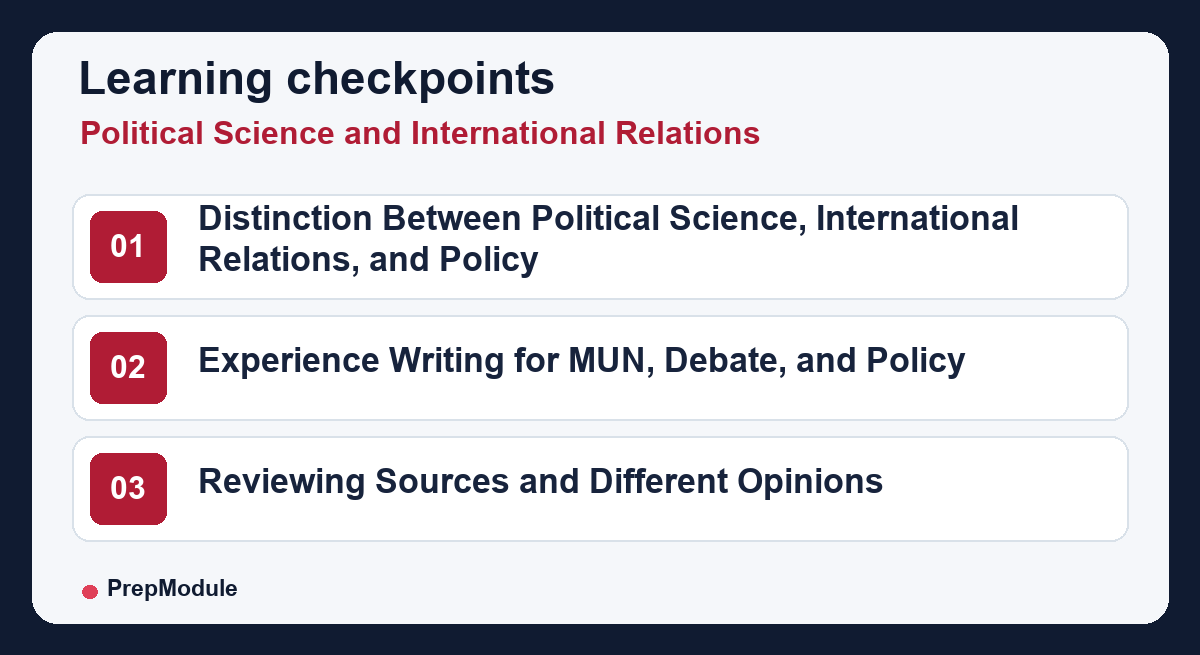
What activities are done in MUN?
MUN is a mock international conference where students take on roles such as representatives of various countries to investigate and discuss international issues. The official UN website provides guidelines and resources that first-time students and teachers can utilize. When researching a country's position, you can experience the process of distinguishing between your current personal thoughts and that country's official stance, and finding negotiable statements.
Debate is an activity where you argue on a given topic and examine opposing claims. You may understand the difference between MUN and Debate and start with one that aligns with your interests. English essay competitions can also be an opportunity for students to independently develop their arguments.
Examples of projects connected to your major
Try setting an accessible policy question, such as "Why is it inconvenient for youth in our region to use public transportation?" Read official transportation data and policy guidelines, review budgetary or operational constraints, and then compare different proposed improvements. Include a paragraph explaining why someone who opposes your conclusion might present a different opinion. There is no need to investigate people's political leanings or personal information.
Recommendations by Grade
For middle school students, I recommend starting by reading and summarizing a current affairs article. In grades 9 and 10, try taking on a minor role in school debate activities or MUN; in grade 11, try exploring specific regional, institutional, or international issues in depth or writing policy briefs. Rather than planning activities with the goal of high positions or awards, it is better to leave a record of your actual contributions to research and debate.
Questions to Read at the High School Level by Major
Political science is a discipline that explains domestic and international political phenomena—such as political institutions, human political behavior, and government and power relations—through various methods. International Relations allows for a greater focus on questions regarding relations between nations, international organizations, cooperation, and conflict. Public Policy examines what policies are possible for specific social problems and how to evaluate their impact and implementation conditions. Look for courses such as Comparative Politics, International Relations Theory, and Policy Analysis and Research Methods in the official curriculums of the universities you are interested in.
For example, let's assume you are reading about cases where various countries cooperate to solve urban environmental problems. The approach from your major may vary depending on whether your interest lies in cooperation between nations and international organizations, the political systems of each country, or the costs and outcomes of actual policies.
Activities You Can Do Besides MUN and Debate
Read publicly available policy explanations from local governments and summarize the policy's purpose, the people affected, expected pros and cons, and any additional materials needed for your judgment. There is no need to collect sensitive information about individuals or specific groups. It is important not to read the materials from only one perspective, but to compare different opinions and explain which evidence supports your argument.
If you participate in MUN and Debate, instead of just recording the number of times your team speaks, you can organize your assigned agenda, reference materials, and the process of revising your arguments after hearing opposing viewpoints. Argumentative essay competitions such as John Locke can be an option for students to practice reading and writing independently. Please check official announcements for actual competition eligibility and submission guidelines.
Connect School Subjects and Activities on a Semester-by-Semester Basis
Concepts learned in various subjects such as History, Economics, English, and Global Politics can be connected to Political Science. Throughout the semester, read relevant materials on social topics of interest and prepare a small comparative report or presentation. Then, record which questions you were unable to answer yet. Basic statistics and mathematics also help in interpreting public policy data. The purpose is not the scale of the activity, but rather to demonstrate the process of students reading evidence and comparing their own arguments with various perspectives.
PrepModule class for students interested in Political Science, International Relations, and Public Policy
Refine areas of interest into questions
Organize topics of interest and school courses taken, such as international cooperation, domestic institutions, urban policy, and international organizations. Reading, analysis, and writing experiences necessary for the major can be discussed during admissions counseling.
Reading and discussion skills
Practice comparing policy arguments and evidence from different reliable sources and explaining your own views and opposing viewpoints. For students preparing for MUN, Debate, John Locke Essays, etc., it is important to study material understanding and argumentation first, rather than just simple presentation skills.
Inquiry regarding tutors
You can check the availability of teachers in the fields of academic research and writing, such as a tutor who is a PhD candidate in Political Science at LSE and an active researcher at Oxford, and select instruction tailored to the necessary topics and the student's level.
Please select an activity that allows you to explain what international issues you are interested in and what materials influenced your thinking.
Official resources
Inquiry regarding preparation for Political Science or International Relations majors
PrepModule supports the learning needs of each student, ranging from international school curriculum to U.S. university admissions. We have teachers specializing in various fields, including a tutor in politics, research, and academic writing who is a PhD candidate in Political Science at LSE and an Oxford researcher.
You are not bound by long-term packages; you can select the subjects and writing areas you need individually and apply for as many times as you desire.
Please let us know your social issues of interest and your experience with MUN, Debate, and essays. We will provide consultation on classes necessary for argumentation, studying political science, research, and academic writing.
